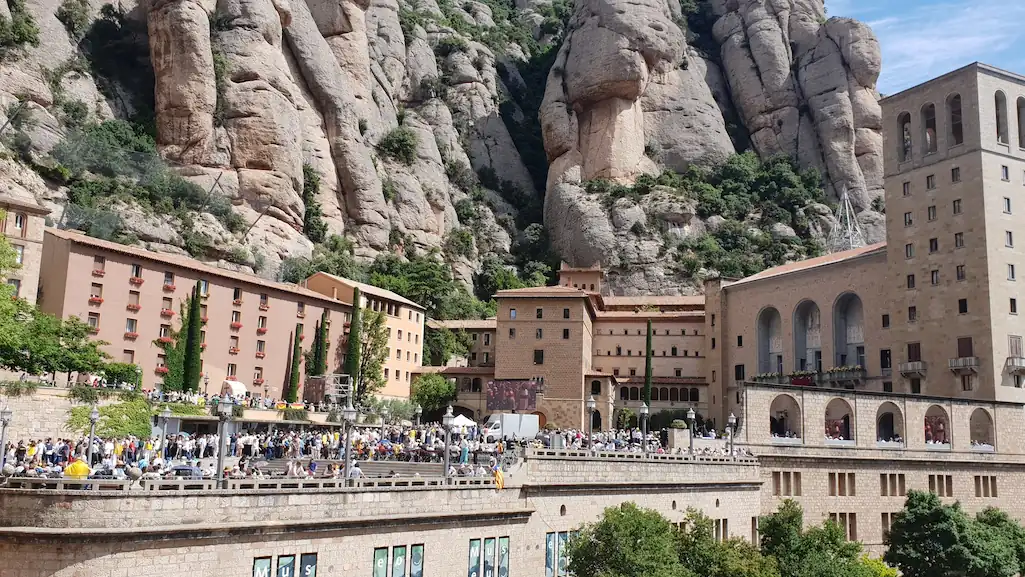
Pope Leo XIV visited Montserrat on 10 June 2026. It was a visit charged with emotion, and one that will inevitably stay in our memory. The Holy Father prayed the Holy Rosary before la Moreneta, patron saint of Catalonia, at midday, spoke to us from the balcony, and showed us his warmth and his enormous gratitude. Forty-four years had passed since the last papal visit to this mountain. This page is a firsthand record of the Pope Leo XIV Montserrat visit, written by someone who was in the square that day.
I was there. Not as a member of the press, just as a neighbor, as one more person who did not want to miss a visit this special. I live in Collbató, at the foot of Montserrat, and I have been walking up this mountain my whole life. I ran into a few neighbors from my town and we shared the joy of knowing we were about to live through a unique moment.
I wrote on this page before, to give information about the papal visit. Now I write to leave a historical record of what happened on 10 June 2026.
How and when: the key facts
| Detail | Information |
|---|---|
| Date | Wednesday, 10 June 2026 |
| Place | Abbey of Santa Maria de Montserrat |
| Main act | Holy Rosary, the Glorious Mysteries |
| Time | Midday, inside the basilica |
| Music | Salve Regina and the Virolai, sung by the Escolania |
| Attendance | close to 8,000 |
| Previous papal visit | John Paul II, 1982 |
| Context | the visit closed the abbey’s millennium year |
Why the Pope Leo XIV Montserrat visit mattered
Montserrat has been receiving pilgrims for a thousand years. A thousand years of a Benedictine monastery loaded with history and tradition. In all that time, only two popes have come to honor this religious center with their presence and to pray before la Moreneta.
John Paul II in 1982 and Leo XIV in 2026. Forty-four long years waiting for a Holy Father to visit the Abbey of Our Lady of Montserrat.
If you do not live around here, it is hard to grasp what this means. Most people come to this place for a day and then leave. For us, it is home. We come almost daily. Living this experience in person is a gift for everyone, but for those of us who live here it carries a special weight.
The date was not random either. The Benedictine community was closing its millennium year, so the visit worked as the ending of a thousand-year celebration. That same morning the Pope had been at Brians prison, meeting with inmates, and in the evening he was at the Sagrada Família. Pope Leo left his warm and deeply humble mark on everyone he met during his journey through Catalonia.
Why I gave up my transport seat and walked up
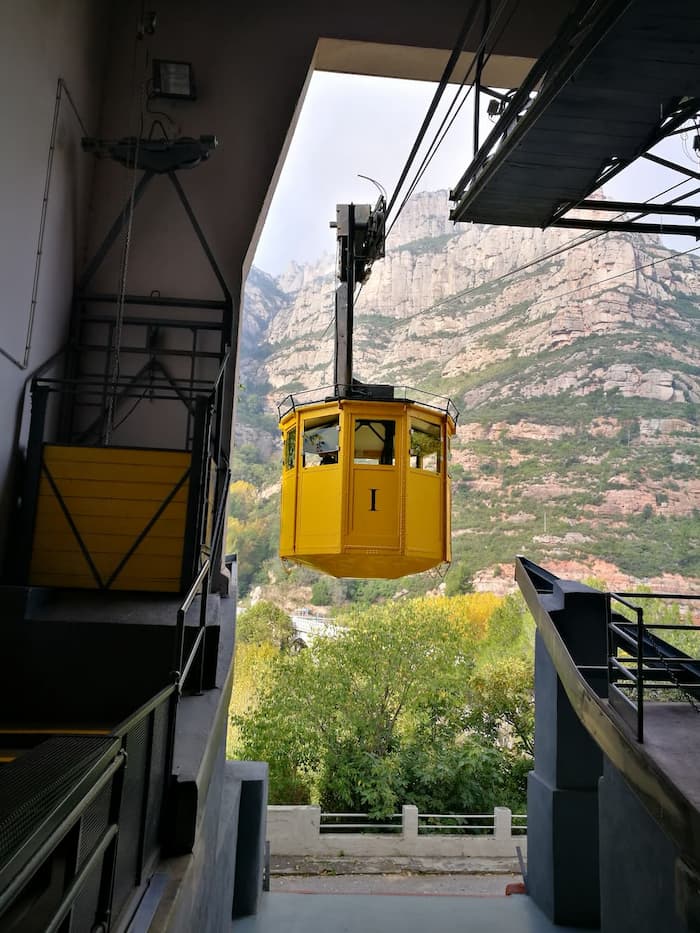
Getting into Montserrat that day required a reservation. I got mine within hours of the visit being announced. I knew I wanted to live that experience firsthand. The rack railway and the cable car were only selling tickets through the abbey’s website, and all reserved places were outside, in the squares, following the prayer on giant screens. The number of people who wanted to attend was enormous, as later became clear.
In the end I decided the best thing I could do was go up the way I had so many times before, on foot, like a pilgrimage, and give up my seat on one of the transport services people could use to reach the monastery. Other people would be longing to feel the emotion of seeing Pope Leo, and helping those people was the best thing I could do.
This time, honestly, it felt like a different trail. You do not walk up to Montserrat to meet the Holy Father every day. Something inside me kept quickening my pace. A wonderful encounter was waiting for me, and that is exactly how it turned out.
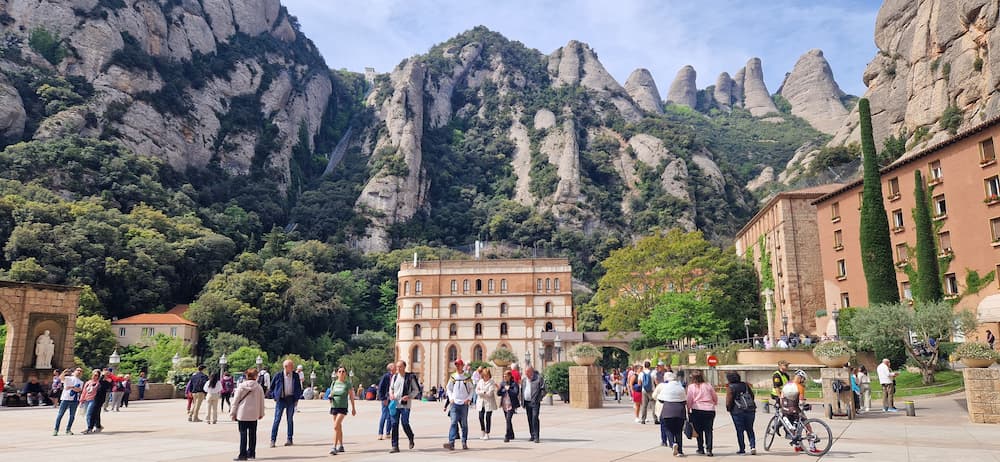
Arriving by those trails I had walked a thousand times, I found a heavy security presence, which was only logical, and I have to say everyone was extremely kind to those of us coming up on the trails to the monastery. The army and the Mossos d’Esquadra carried out the checks, and by 11:00 in the morning you could already feel the buzz throughout the complex and in the main square.
I was supposed to go to one of the central zones of the main square, in front of the great monastery façade, but I decided I would rather wait for the Holy Father on the access road, and then I would surely still be able to go up to the square and take my seat. There were huge numbers of people and there was nothing to do but stay there, waiting, with our excitement held in.
Seeing him for the first time
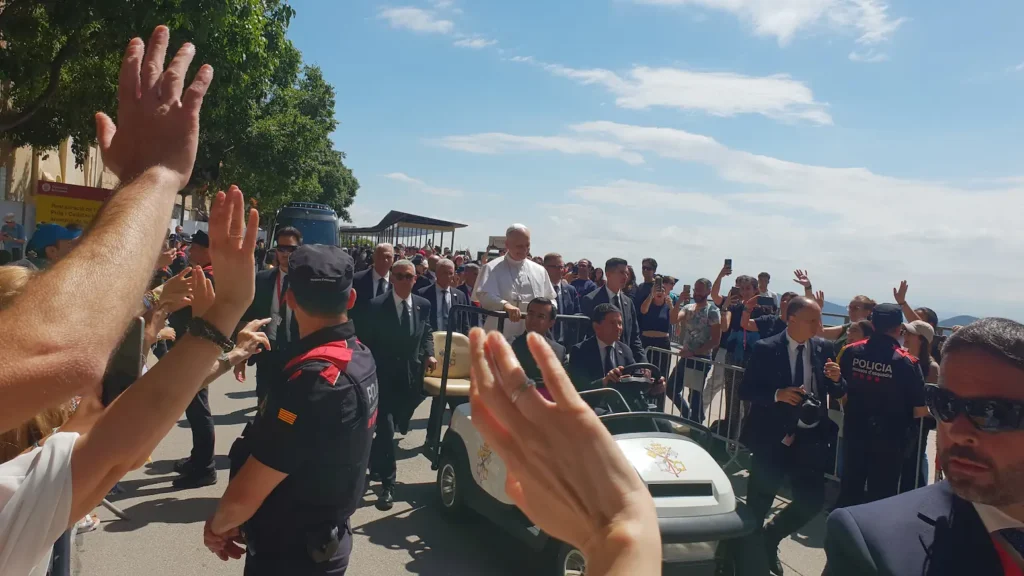
There was a lot of anticipation. We crowded together respectfully, waiting for the big moment. I remember some workers saying, “He’s coming, he’s coming!” I thought maybe they had inside information. We looked at each other and they said word had gone around that he would be there in five minutes. We were watching, we moved closer to the barrier, guarded at all times by the security forces, and then we started to hear the roar. At the Mirador dels Apòstols, the Holy Father appeared. With a wonderful smile and showing all his kindness, he came closer through cheers and shouts of affection.
That is where I saw him, and I saw him up close. It was a very special moment.

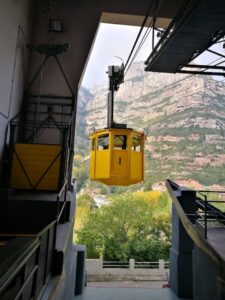
The Holy Father’s welcome procession passed right in front of the upper rack railway station. If you have ever come up on the rack railway, you will recognize it instantly. The same platform where you step off the Montserrat rack railway on any ordinary Tuesday, except that this time, on the way out, the outside was decked out with special decorations for Pope Leo XIV’s visit.
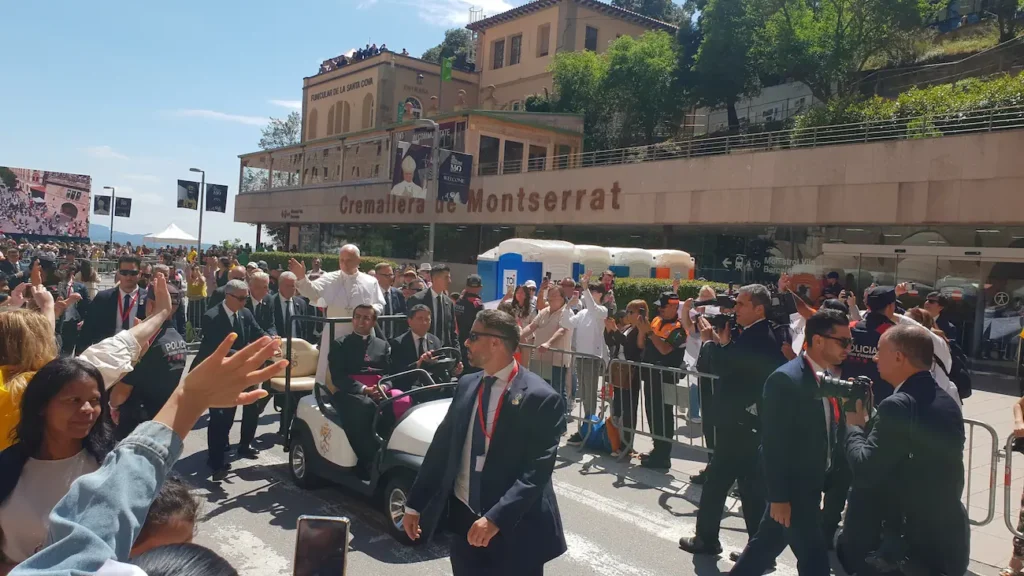
That day the crowd was mixed. I could hear cheers in Catalan and in other languages, there were flags from Latin America, and all kinds of people from different places had come to an event that turned out to be unique. The diversity was palpable and everyone was cheering the Pope.
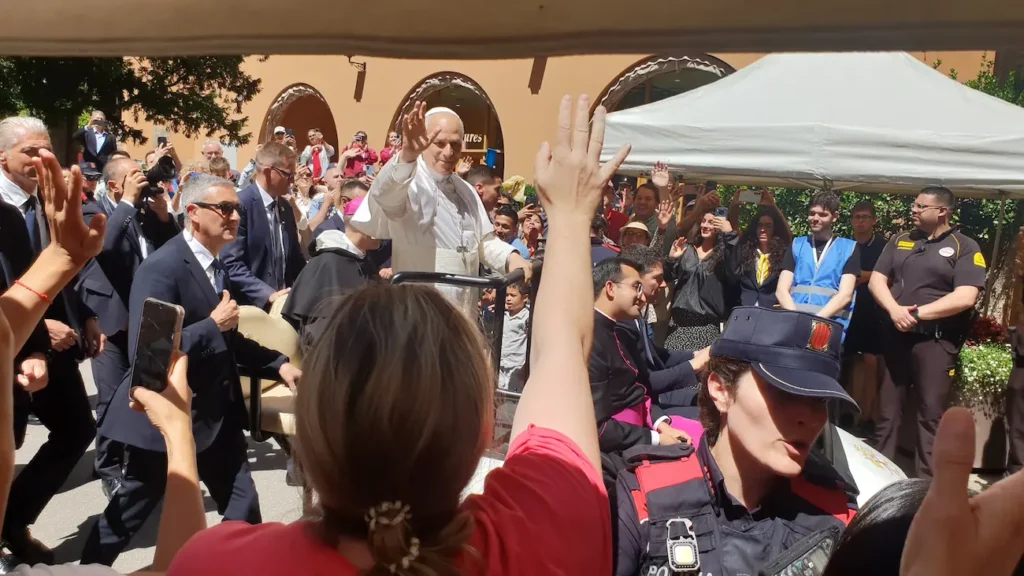
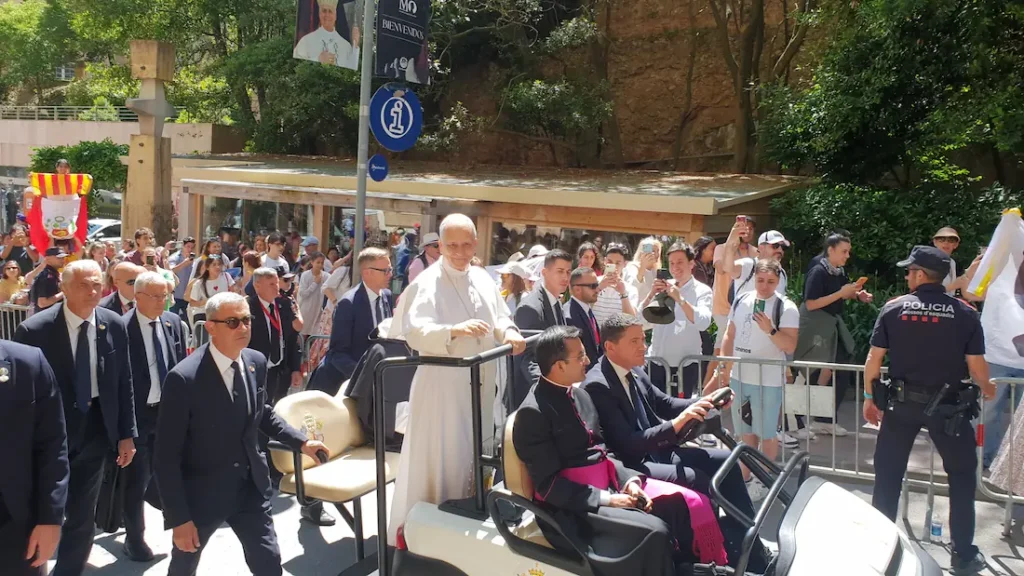
Midday in the square of the Abbey of Our Lady of Montserrat
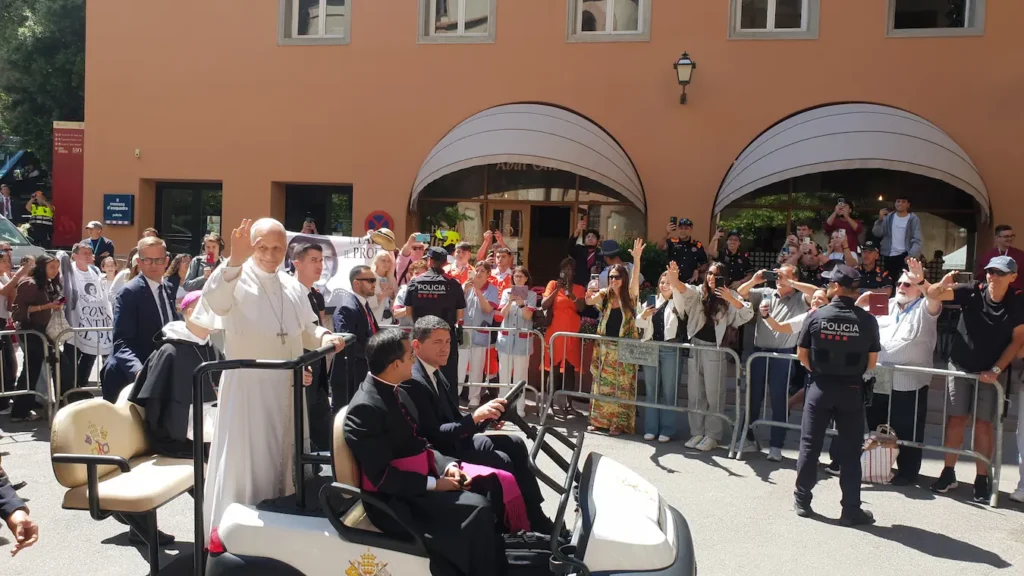
The Holy Father arrived at midday at the spiritual heart of Montserrat, and waiting for him in the atrium were the abbot of the Monastery of Montserrat, Manel Gasch i Huriós, and the bishop of the diocese of Sant Feliu de Llobregat, Monsignor Xabier Gómez García, together with around 800 schoolchildren from Catalan schools. The bells were ringing out loudly to mark such a special moment.
I could have waited in my seat in the main square and welcomed the Holy Father in the emblematic square of the Benedictine monastery. But seeing Pope Leo arrive along the monastery’s main road was an incredible experience too, and he really was very close to everyone who was there.
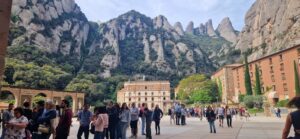
Later, when the Holy Father entered the basilica, the security forces let through all of us who had been waiting impatiently to get to our places. As I walked in I realized how many people were in the square. I headed toward the zone where I was assigned to watch the event. I went through barrier after barrier, and when I reached my spot I found how incredibly packed the area was. I looked up, spotted a free seat, sat down, and we followed the event on the outdoor screens.
Inside the basilica, the Holy Father prayed briefly in the Chapel of the Blessed Sacrament and then made his way to the presbytery. Then, after the addresses by the bishop and the abbot of the Monastery of Montserrat, Pope Leo presided over the Holy Rosary with the Glorious Mysteries.
Standing in that square with several thousand people praying at the same time, in Catalan, in Spanish and in a dozen other languages, was an enriching experience. It started at twelve, right on time, and thousands of people took in every one of Pope Leo XIV’s words with admiration.

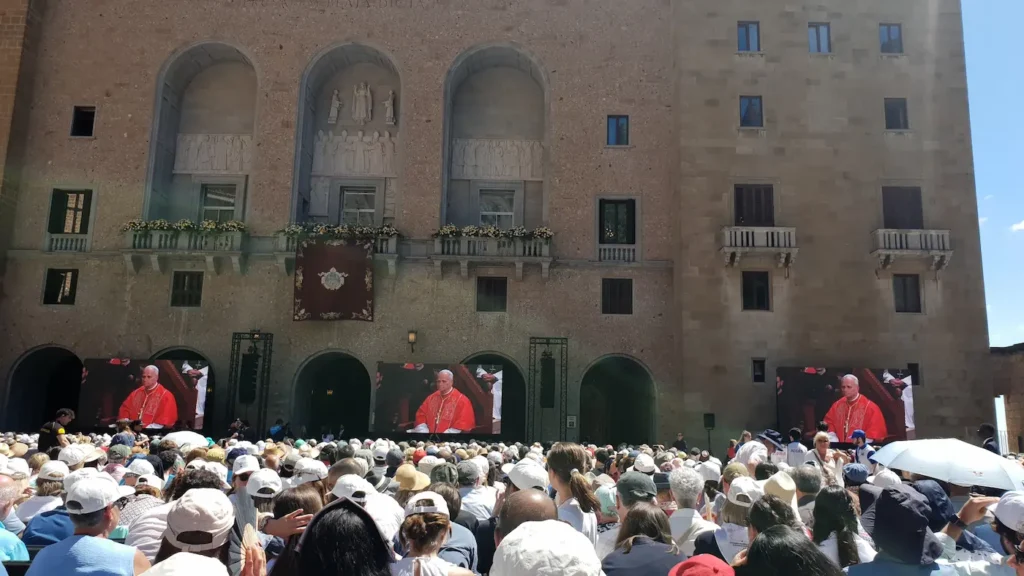
The Salve and the Virolai, marks of identity
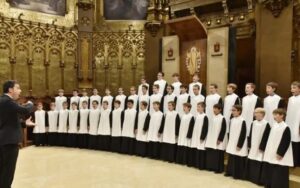
The Escolania de Montserrat is one of the oldest liturgical boys’ choirs in Europe. They have been singing in this basilica since the 14th century. On this occasion, in the presence of the Holy Father, the Escolania de Montserrat performed, together with the Capella de Música de Montserrat and a fortunate small group of musicians, the Salve Regina in its eight-voice echo version by Joan Cererols, a monk and composer who lived at Montserrat between 1618 and 1680.
Next, the choir sang the Virolai, the hymn to the Mare de Déu de Montserrat. Written by Mossèn Jacint Verdaguer and set to music by Josep Rodoreda, it was one of the most moving moments of the day. The Virolai is not just a melodic song. For Catalans it is a sung mark of identity that represents us.
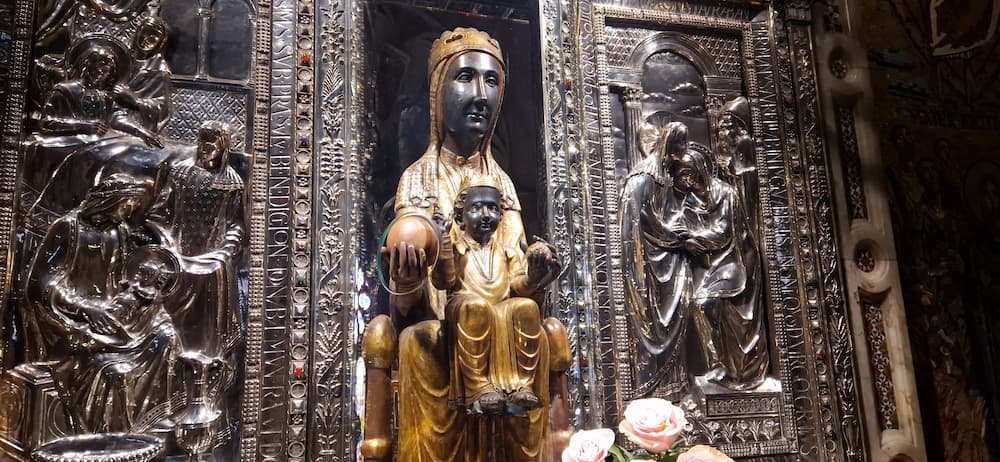
During the final verses sung by the Escolania, the Holy Father moved to the cambril, the chamber above the altar where the image is kept, to venerate the Mare de Déu de Montserrat.
What he said, and how he said it
Pope Leo XIV spoke to address everyone present and offer them a few words in his Holy Rosary address at Montserrat. He spoke to the faithful mostly in Catalan, and it created a wonderful moment of connection with Catalan society. Nobody expected it, and the square burst into applause, showing all its affection for his simplicity and for the remarkable way he connected with those who were waiting to hear him.
Beautiful words about the Virgin that reached the heart of everyone there: the Virgin invites us to recognize one another as brothers and sisters, where no one is excluded and where communion is stronger than any division.

The Peru connection and la Moreneta
Pope Leo showed everyone, and especially the Christian community in Catalonia, his bond with the Mare de Déu de Montserrat, la Moreneta, when he said these words in his Holy Rosary address: “Amb emoció he recordat els meus anys com a rector de la parroquia de Santa Maria de Montserrat, a Trujillo, Perú. La Moreneta sempre m’ha acompanyat. Gràcies, Catalunya, per la vostra fe.” I have remembered with emotion my years as parish priest of Santa María de Montserrat in Trujillo, Peru. La Moreneta has always been with me. Thank you, Catalonia, for your faith.
Before being named Pope of the Catholic Church, Leo XIV, Robert Francis Prevost, spent years as a missionary in Peru, where he served in Piura, Chulucanas, Trujillo and Chiclayo. In Trujillo, Pope Leo XIV was parish priest of the parish dedicated to Santa María de Montserrat. The Holy Father moved everyone present with his words: “Estic content de poder estar als peus de la Moreneta per encomanar-li, ple de confiança en la seva intercessió maternal, el meu servei petrí i la missió de l’Església en el món que clama demanant justícia i pau.” I am glad to be able to come to the feet of la Moreneta to entrust to her, full of confidence in her maternal intercession, my Petrine service and the mission of the Church in a world crying out for justice and peace.
The message of thanks from the balcony
The Holy Father addressed everyone gathered from the balcony on the monastery’s main façade and thanked the Catalan community for its affection and its warmth in the finest terms: Thank you to Catalonia for welcoming so many people from other countries, because it shows how to bring everyone together into a single family.

The Holy Father’s messages were warm and full of meaning, offering words of love to everyone present. He stressed one message above all: a reminder to everyone that faith gives life and faith gives hope.
Listening to His Holiness Pope Leo speaking to the believers gathered there was a moment of great emotional weight. The faithful returned the Pope’s affection with songs, thanking him and cheering him, with enormous joy and happiness.
Popes at Montserrat: 1982 and 2026
| John Paul II | Leo XIV | |
|---|---|---|
| Date | 7 November 1982 | 10 June 2026 |
| Trip | First papal visit to Spain | Apostolic journey to Spain, 6–12 June 2026 |
| At Montserrat | Prayer before la Moreneta | Holy Rosary, the Glorious Mysteries |
| Gap | — | 44 years later |
These figures show the time that passed between the two papal visits to the sanctuary of Montserrat.
Frequently asked questions
When did Pope Leo XIV visit Montserrat?
On Wednesday, 10 June 2026, during his apostolic journey to Spain. He arrived just before midday and presided over the Holy Rosary with the Glorious Mysteries at noon.
How many popes have visited Montserrat?
Two, on record. John Paul II in November 1982 and Leo XIV in June 2026. Forty-four years apart, in a monastery that recently turned a thousand years old.
How many people were there?
Close to 8,000, all with an advance reservation. Around 800 of them were schoolchildren who welcomed the Pope in the atrium of the basilica.
Did the Escolania sing the Virolai for the Pope?
Yes. The Escolania sang the Salve Regina, in the eight-voice version by the Montserrat composer Joan Cererols (1618–1680), and then the Virolai, with words by Jacint Verdaguer and music by Josep Rodoreda. The Pope went to venerate the image of the Virgin, the Mare de Déu de Montserrat, while the choir sang the final verses.
What language did he speak in?
Mostly Catalan, also Spanish, and he finished by reciting a verse of the Virolai.
Why is Pope Leo XIV connected to Montserrat?
Before being elected Pope of the Catholic Church, Robert Francis Prevost was a missionary in Peru, where he was parish priest of the parish of Santa María de Montserrat in Trujillo. He said at the abbey that la Moreneta had always been with him, which was a great joy for everyone present.
Can you visit Montserrat normally now?
Yes. The restrictions applied only on 10 June 2026. Everything has been running on the normal schedule ever since: rack railway, cable car and funiculars included.
About these photos and videos
I took every photograph and video on this page while I was present at the papal visit to Montserrat on 10 June 2026.
Four of these photographs are available on Wikimedia Commons under a CC BY-SA 4.0 licence, free for anyone to use with attribution. The three videos are on YouTube under a CC BY licence.
If you need any of this material in higher resolution, or a photograph that is not on Commons, write to me and I will send it over. All I ask for is credit and a link.
Continue exploring Montserrat
If this guide helped you plan your visit, then it has done its job.
I’m based in Collbató, at the foot of Montserrat, and have been hiking and exploring the mountain for more than 20 years. Author of The Ultimate Montserrat Hiking Guide Book.
Some links may be affiliate links, at no extra cost to you.