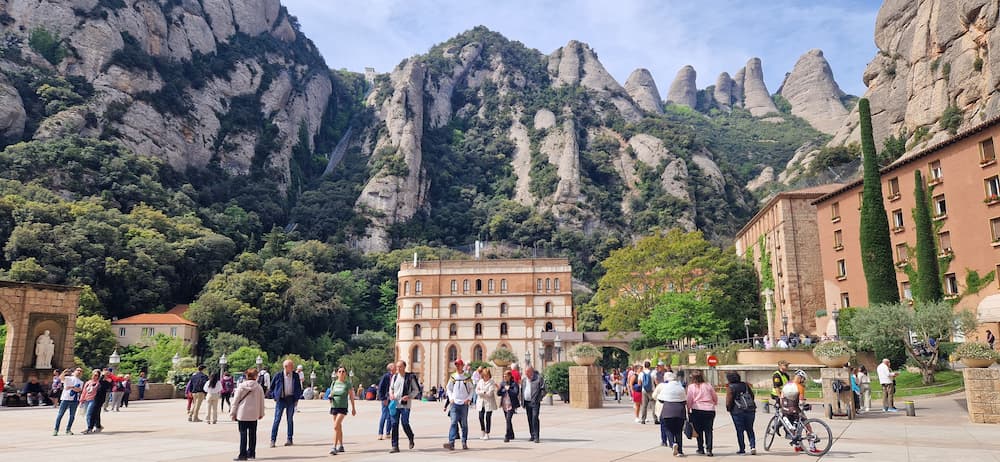

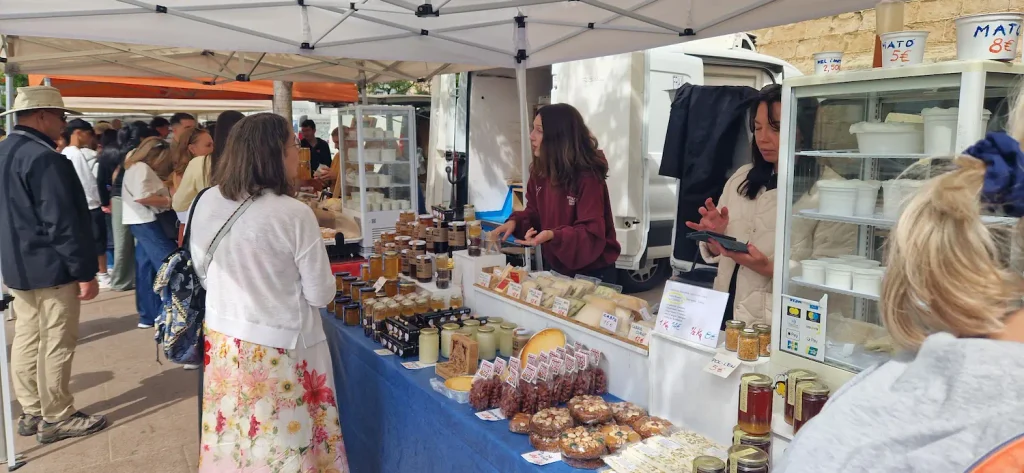
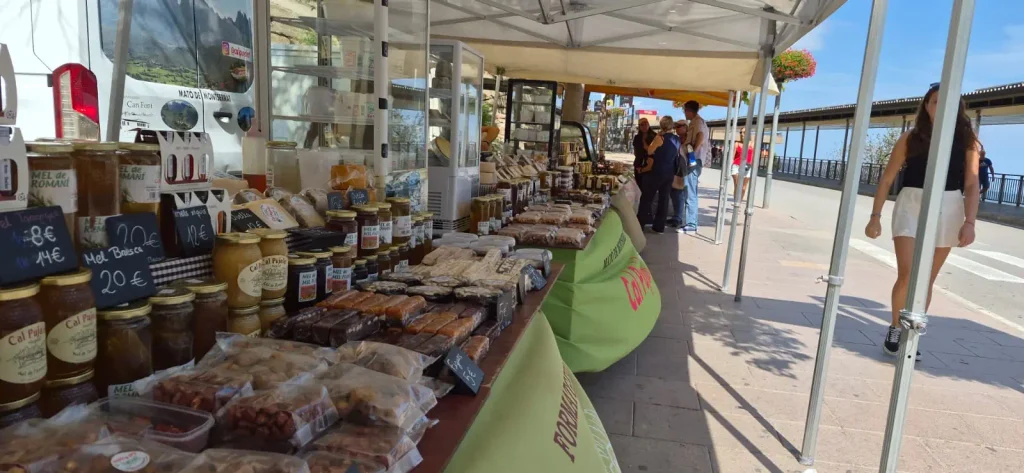
Just below the monastery, a short line of stalls sells fresh cheese, honey, nuts and dried fruit every single day. It looks like an ordinary souvenir market, and most visitors walk past it on their way to the basilica. It isn’t. This is the Mercat de les Pageses — the peasant women’s market — and the families behind those tables have been climbing this mountain to sell here since the middle of the 19th century.
This short guide explains who the matonaires are, what Mató de Montserrat actually is, how the market came to exist, and why the stalls are never quite in the same place twice.
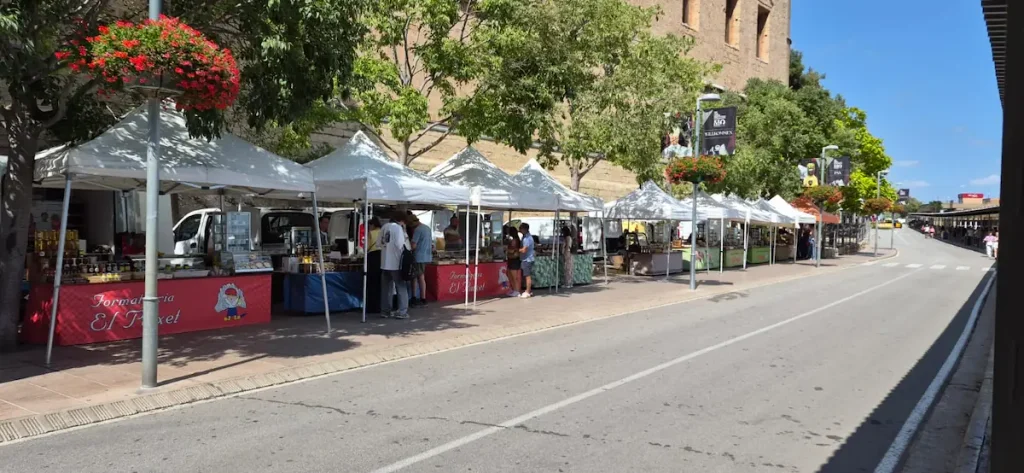
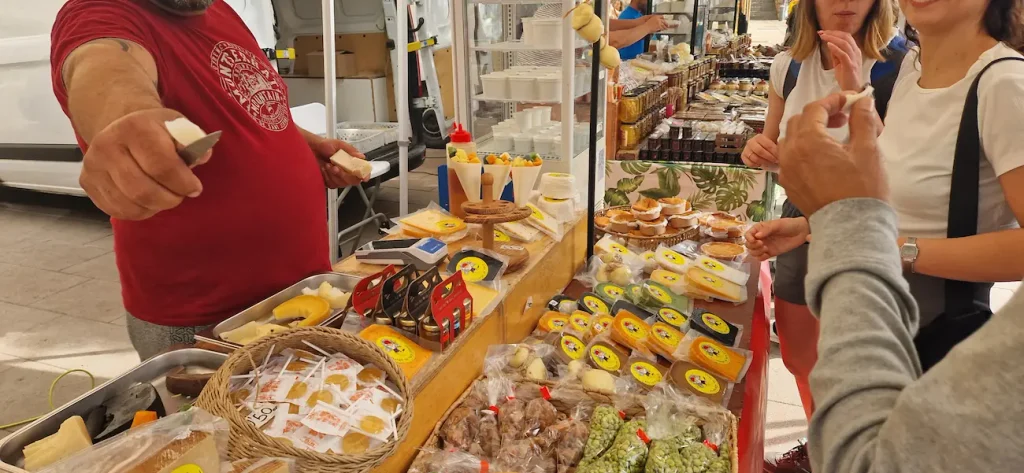
The market stalls below the monastery are the Mercat de les Pageses, run by the matonaires — farming families from the villages on the north face of Montserrat. Their star product is Mató de Montserrat, a fresh, unsalted curd cheese traditionally curdled with artichoke thistle. The market dates back to the mid-19th century; of the nearly fifty stalls it had in the first half of the 20th century, only seven families remain, and the right to sell here can only be inherited. Stall positions are decided by an annual draw and now rotate weekly.
Who are the matonaires?
The matonaires are the rural farming women of the villages on the north face of Montserrat, who traditionally climbed the mountain to sell their fruit, vegetables, poultry, rabbits and — above all — the Mató cheese that gives them their name. Their market at the abbey supplied the monastery’s visitors, some of whom would stay for days.
Geographically, they came from Sant Cristòfol de Castellbell i el Vilar and Marganell, and from the hamlets of Serrat de les Cametes and Vilamarics, in the municipal areas of Bruc and Monistrol de Montserrat. The right to sell at Montserrat was passed down from generation to generation, giving rise to an inherited privilege that has survived to this day.
Mató de Montserrat: the cheese behind the name
In the late 19th century some of these women began making Mató at home from the goat’s milk they had left over, and carrying it up to Montserrat to sell. Little by little this fresh, unsalted, curdled cheese became the area’s most emblematic product — and the women became known as matonaires.
The traditional method is disarmingly simple. The milk was boiled in a pot and left to cool; the women tested the temperature with their fingers — neither too hot nor too cold — before adding artichoke thistle, a plant of the artichoke family used to curdle it. Once curdled, the cheese was drained and pressed into moulds, usually of one kilo, then sold in individual pieces served on a fresh cabbage leaf.
Mercat de les Pageses de Montserrat: how the market began
The reasons behind the founding of this mountaintop market are not entirely clear, but they date back to the mid-19th century. Some of the matonaires attributed it to the phylloxera plague, which devastated winegrowing — at the time the main source of income for local farmers. Others said it grew out of the cholera epidemic that ravaged Barcelona in those years, which sent many people on pilgrimage to take refuge at Montserrat.
Faced with the need to feed all those newcomers, the monastic community called on the peasants of the villages on the mountain’s north face to sell what they harvested and prepared at home: fruit, vegetables, poultry and eggs, rabbits, bread, nuts, honey and, of course, Mató cheese. The stalls were first set up right in front of the basilica itself, then moved over the years to the Plaça de l’Abat Oliba, and later to their current spot.
From fifty stalls to seven families
The original market was made of very basic stalls: simple wooden boxes as a surface for displaying the Mató, with baskets of fruit, vegetables, poultry and rabbits set on the ground, and the matonaires sitting behind them on folding wooden stools. During the first half of the 20th century the market had nearly fifty stalls.
Today only seven remaining families have kept up the rights and duties of selling at the market. Those rights are limited to inheritance and can only be handed from one generation to the next: no new matonaire family can join, and if a generation stops selling, that stall cannot be brought back.
Those strict rules, together with the textile factory boom as an alternative livelihood, the abandonment of traditional rural life and the housing developments built on the old croplands, are what shaped the market’s decline to this day.
Two hours up, two hours down
Before the roads and the railways, getting the goods here was the hard part. The matonaires left their farmhouses before sunrise to be the first to arrive at Montserrat, a basket on each arm and a mule carrying the rest up long, steep paths. They went in company — other peasant women, sometimes their children or grandchildren — and where the trail got particularly steep they would grab the mule’s tail to be pulled up.
They were often frightened by the sounds of the night, including the hoot of the tawny owl (Strix aluco), and many of them told stories of when wolves (Canis lupus) still roamed the mountain. The way back, at midday or in the early afternoon, was far more relaxed: they came down together, joking and swapping stories about that morning’s customers. Between the climb and the descent, it cost them roughly two hours up and two hours down, every day.
Those old routes still exist and are signposted as the Camins de les Matonaires: from Sant Cristòfol via the Camí de la Calcina, from Sant Cristòfol via Santa Cecília, from Marganell via Santa Cecília, from Marganell via Ca l’Oliver, and from Serrat de les Cametes.
The Montserrat market stalls today
Of the fifty or so farmhouses and cottages that once produced Mató on the north face of Montserrat, only a small number of families still do, in the area running from the Revolt de la Paella to the Agulla de Sant Jeroni and from the Roca Foradada across the whole valley of the Marganell stream. These are the producers who never abandoned the activity and who, generation after generation, kept the right to sell at the Mercat de les Pageses.
The cheesemaking families of Marganell still work by the traditional artisan method, with the recipes and the patience of their great-grandmothers, grandmothers and mothers — first in their own kitchens, now in proper workshops. Technical improvements and health controls have been introduced, but the specific traditional process is respected, which is what makes this Mató smoother and more distinctive. To protect its name, origin and quality, the families have formed an Association of Producers.
Today, in their current location below the monastery, the matonaire families bring their products up to Montserrat every day so visitors from all over the world can try them. One detail worth knowing: the exact spot of each stall is decided by an annual draw, and since the latest draw the stalls rotate position every week. So if you came back last year and remember exactly where a particular family was standing — don’t count on it.
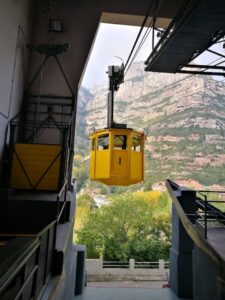
Not sure where the stalls sit in relation to the basilica, the rack railway station or the cable car? Our interactive map of Montserrat shows the whole sanctuary area with numbered hotspots, so you can see exactly where the market is before you arrive — and work out what else is a two-minute walk away.
FAQ — The market stalls at Montserrat
What is the market at Montserrat called?
It is the Mercat de les Pageses — the peasant women’s market — run by the matonaires, the farming families from the villages on the north face of Montserrat.
What is Mató de Montserrat?
A fresh, unsalted curdled cheese, traditionally made from goat’s milk and curdled with artichoke thistle. It was drained, pressed into moulds of about one kilo and sold in individual pieces on a fresh cabbage leaf.
Who are the matonaires?
The rural farming women of the villages on the north face of Montserrat — Sant Cristòfol de Castellbell i el Vilar, Marganell, and the hamlets of Serrat de les Cametes and Vilamarics — who climbed the mountain to sell fruit, vegetables, poultry, rabbits and Mató cheese.
How many stalls are there at the Montserrat market?
During the first half of the 20th century the market had nearly fifty stalls. Today only seven families remain, and the right to sell there can only be inherited from one generation to the next.
Are the stalls always in the same place?
No. The specific location of each stall is decided in an annual draw, and since the latest draw the stalls are moved every week in a rotation.
Continue exploring Montserrat

If this guide helped you plan your visit, then it has done its job.
I’m based in Collbató, at the foot of Montserrat, and have been hiking and exploring the mountain for more than 20 years. Author of The Ultimate Montserrat Hiking Guide Book.
Some links may be affiliate links, at no extra cost to you.