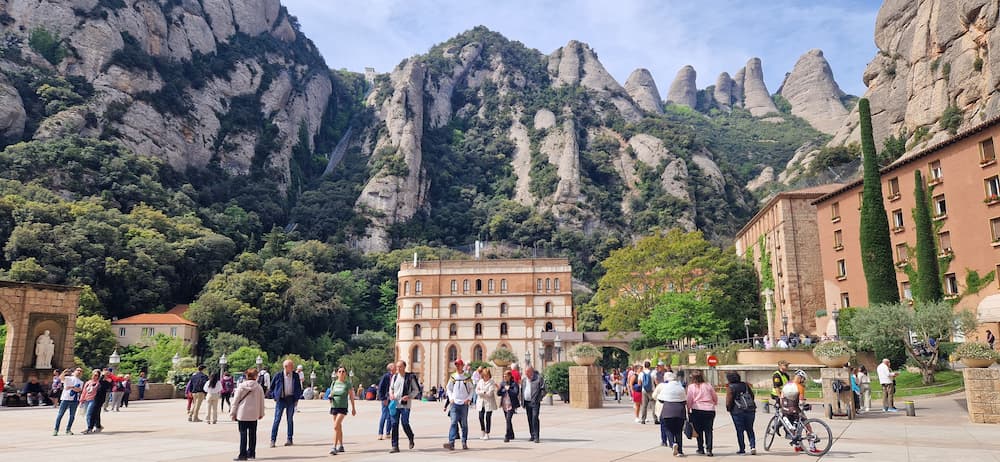
The Montserrat hermitages hike, which takes in all 13 chapels, is probably one of the most rewarding experiences you can have in the mountains. It’s not your typical tourist stroll, nor is it an easy trail that starts at the monastery. It’s a long and challenging hike, but it’s also one of the most spectacular ways to truly capture the essence of Montserrat.
In our case, we set out from Santa Cecília, ascending directly toward Sant Jeroni, the highest point of the massif and one of Montserrat’s most popular hiking trails. From there, we connect through many of the ancient hermitages that for centuries formed one of Catalonia’s most important hermitage complexes.
The result is a roughly 7-hour hiking route through Montserrat that combines steep ascents, technical sections, poorly marked areas, and, above all, the constant feeling of exploring a much wilder and less touristy side of the mountain.
If you’re looking for one of the best hiking routes in Montserrat and have some mountain experience, this could be an incredible option. But it’s not for everyone.
Contents
 From the author
This trail is one of the 15 I mapped for my Montserrat hiking guide.
From the author
This trail is one of the 15 I mapped for my Montserrat hiking guide.
What is the Montserrat Hermitages hike 13 hermitages route?
The Montserrat hike of the 13 hermitages is not a marked trail as such, but a hiking route that connects different paths across the massif to visit ancient hermitages scattered throughout the mountain.
These hermitages are part of the eremitic life of Montserrat, a very important phenomenon for centuries, where hermits lived in isolation deep in the mountain, in an environment designed for contemplation, silence and spirituality. In fact, many historical accounts already described Montserrat as one of the best places for retreat.
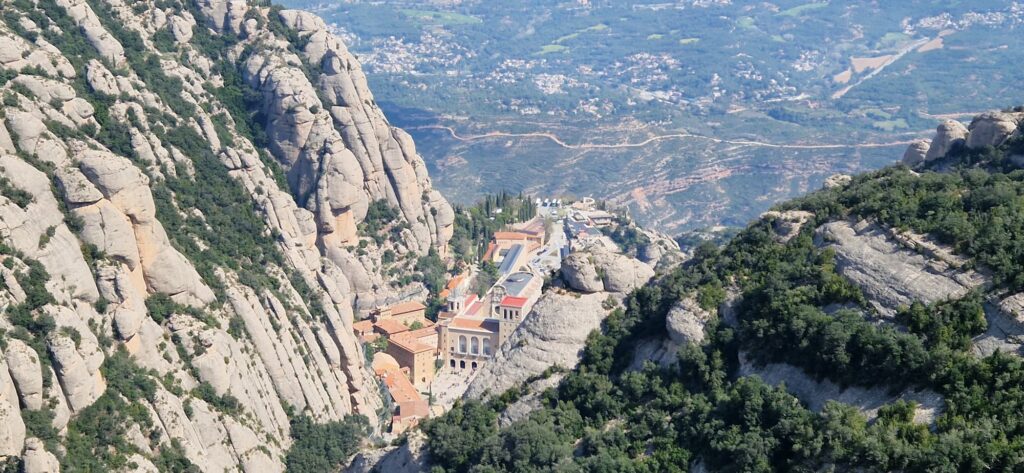
Today, some of the hermitages are still quite well preserved, others have been rebuilt and many remain in ruins. But beyond their condition, what really matters is what the whole set represents: a way of understanding the mountain from within.
Doing this Montserrat hike is not just about walking. It’s about crossing a large part of the massif, linking historical paths, with constant views and the feeling of moving through the history and past of the mountain.
Route Technical Details
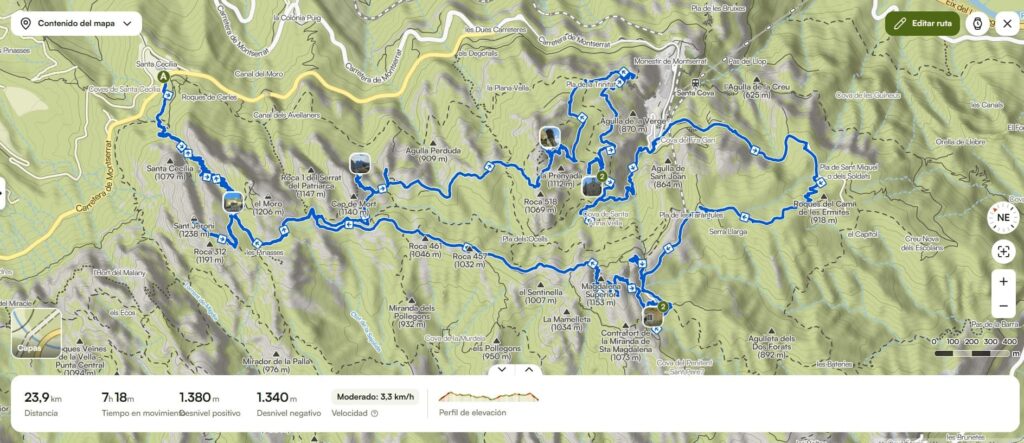
Distance: 23.9 km
Duration: 7h 18min
Elevation gain: 1,380 m
Difficulty: High (if completed)
Route type: Circular
Starting point: Santa Cecília (Montserrat)
This Montserrat hike of the 13 hermitages is demanding if done in full. It’s not a tourist walk or a typical route from the monastery.
The total duration is around 7 hours, although actual moving time is closer to 4 and a half hours, depending on your pace and how often you stop, as there are many points worth taking a break.
The difficulty is high, especially if you start from Santa Cecília, climbing directly towards Sant Jeroni. This is the most direct and demanding way to reach the highest peak in Montserrat. In this other article, I explain the six best ways to reach the summit of Sant Jeroni.
If instead you start from the monastery, the route becomes much more accessible, although it’s still not suitable for everyone.
Route Map
Here you can see the complete route for this hiking trail in Montserrat (the Santa Cecilia variant) or (the variant starting from the Monastery, which is much easier). It’s highly recommended to follow the route using a GPS, as there are sections that are poorly marked where it’s easy to stray off the path.
Montserrat Hermitages Hike: History, Location and What to See
For centuries, Montserrat was not only a monastery, but also an important center of hermitic life. Hermits lived in isolation across different parts of the mountain, in small hermitages scattered throughout the massif, seeking silence, solitude and contemplation.
This way of life already existed in the Middle Ages, even before the monastery was fully established. Over time, it became more structured and eventually came under the authority of the abbot, integrating into the monastic life of Montserrat.
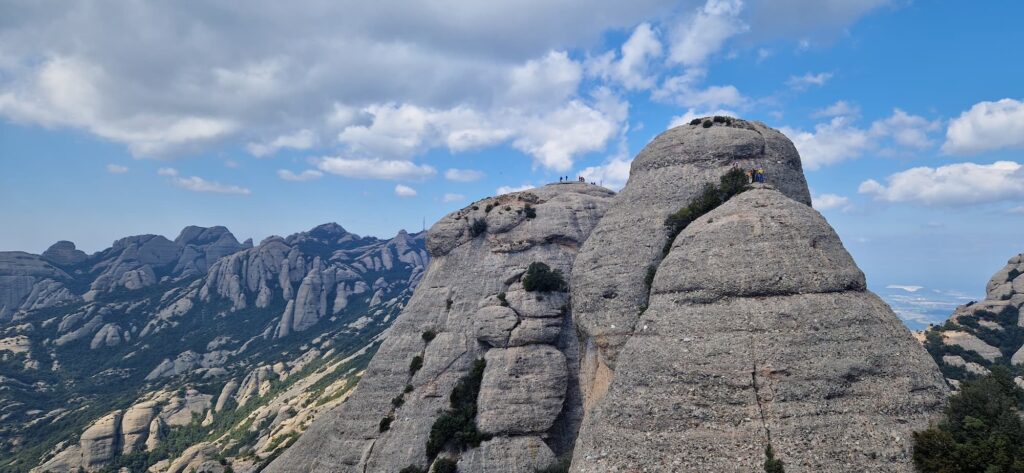
The hermitages were not built at random. Many were originally created using natural caves or rock shelters, and later expanded or relocated. Their location, often in elevated or hard-to-reach areas, was a direct reflection of that search for isolation.
At certain times, there were more than a dozen active hermitages, although the number changed over the years. Hermitic life gradually declined and eventually disappeared in the 19th century, following the destruction caused by the Peninsular War.
Today, exploring the hermitages of Montserrat is also a journey through this part of its history. It’s not just a hiking route — you’re walking through the same places where, for centuries, a completely different way of life existed.
These are some of the most representative hermitages you can see along the route:
Sant Jeroni
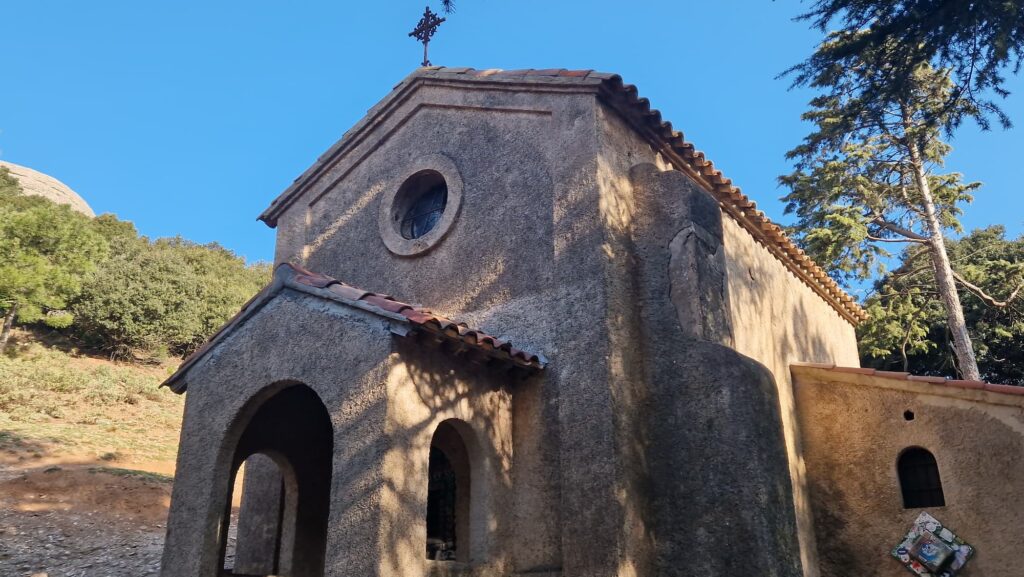
The hermitage of Sant Jeroni was one of the most isolated and highest in Montserrat, located very close to the current summit, the highest point of the massif. It was not always inhabited, as the conditions in this area were harsh and exposed. Even so, it played a key role in the hermitic life of Montserrat, chosen precisely for its isolation and its privileged views.
Today, the original hermitage no longer exists. It was destroyed in 1812 during the Napoleonic invasion and was never rebuilt. A small chapel was later constructed in the surrounding area. Despite this, the location remains one of the most spectacular spots on any hiking route in Montserrat. From the nearby summit, on clear days, you can see as far as the sea and even the Balearic Islands.
Sant Antoni
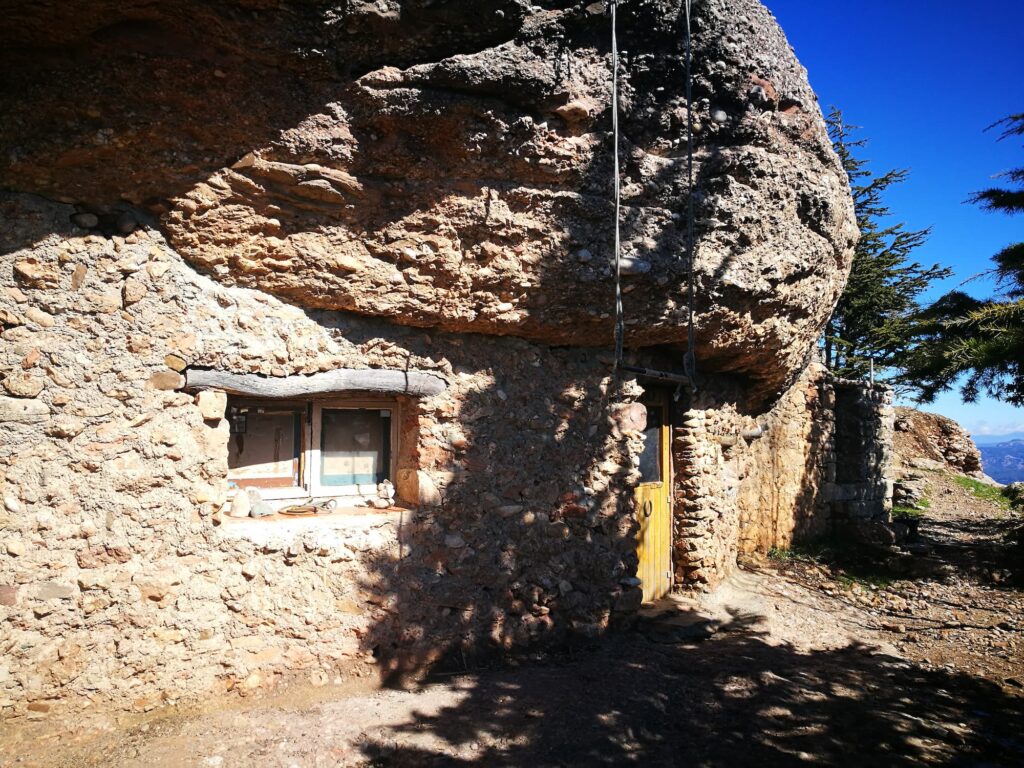
The hermitage of Sant Antoni is located in a very characteristic area of Montserrat, near Cavall Bernat, one of the most iconic rock formations in the massif. Its exact origin is unknown, but it is known that it was initially built in a more inhospitable location and later relocated.
The hermitage as we know it today was restored at the end of the 15th century and included basic elements such as water cisterns, essential for hermitic life. It was destroyed in 1812 during the Peninsular War, and today only a few remains are left.
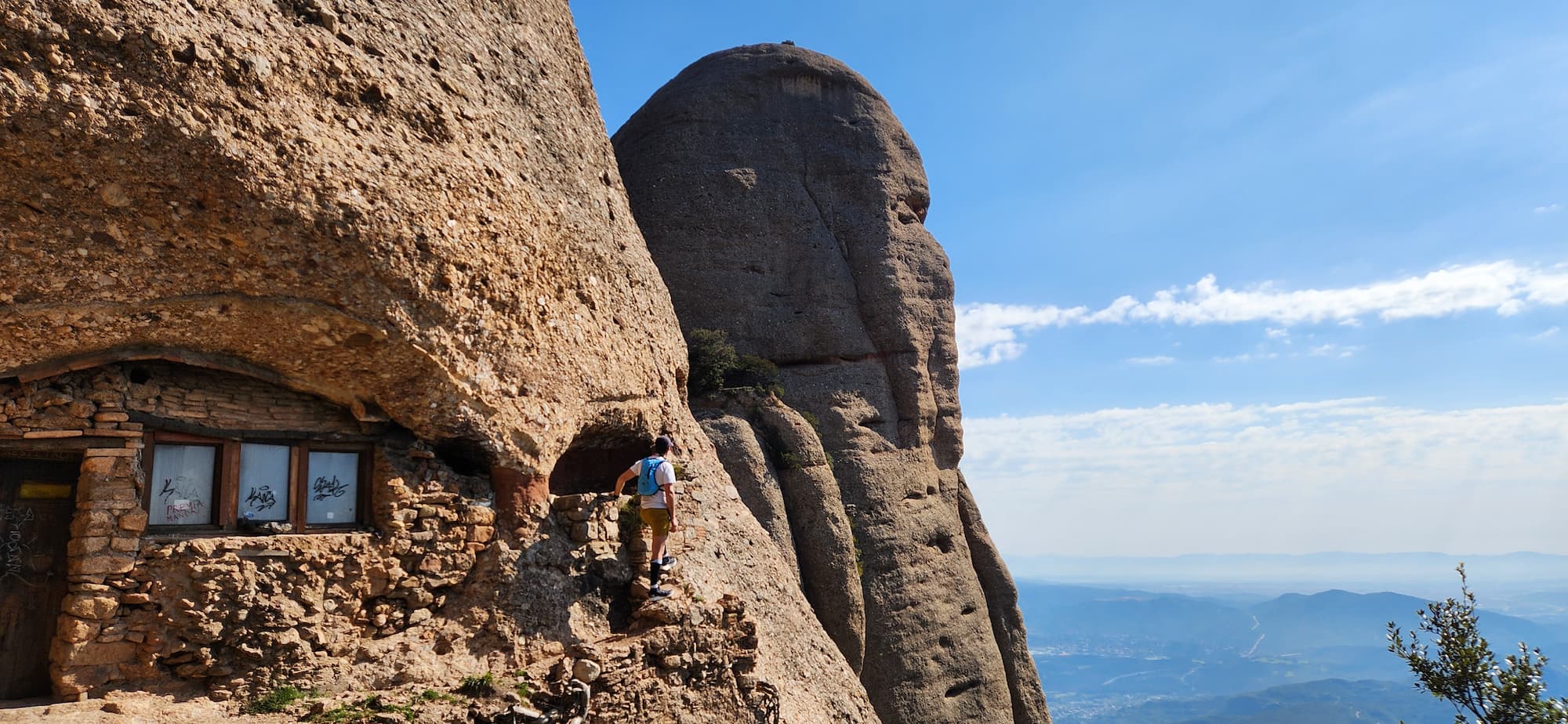
Even so, a reconstructed hermitage now stands in the area where the original once was. It is a privileged spot to enjoy spectacular views of Cavall Bernat and one of the best natural viewpoints along this hiking route in Montserrat.
Sant Salvador
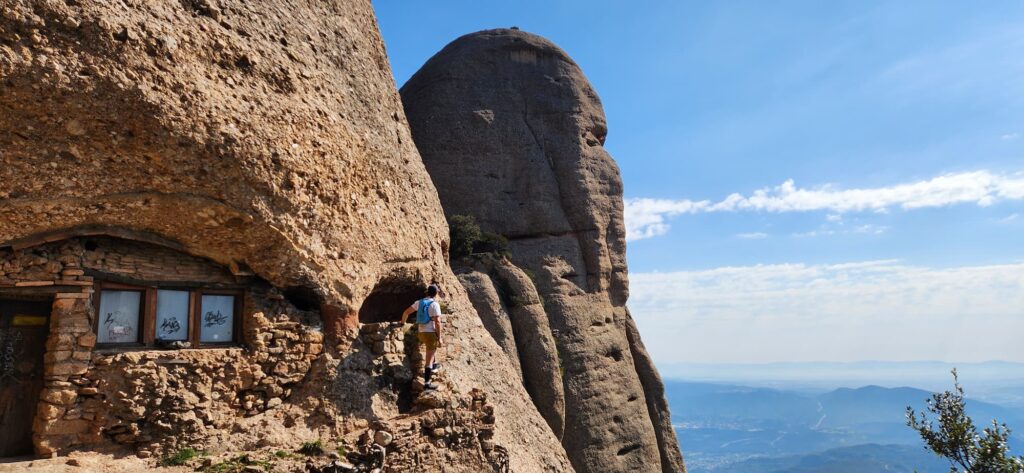
The hermitage of Sant Salvador, also formerly known as the Transfiguration, was located in one of the highest areas of Montserrat, surrounded by the characteristic rock pinnacles of the mountain. Its location was not always the same, as it was initially set in a more exposed area before being established in the place where its remains can be found today, along with the current hermitage at the base of the iconic Elephant Rock formation.
This is a site with a long tradition of hermitic life, already documented in the Middle Ages. The hermitage made use of natural features of the terrain, such as a large rock shelter that was likely the origin of the first refuge and later became integrated as an oratory within the complex. This way of adapting the rock into a living space is very representative of how hermits lived in Montserrat.
Today, only the ruins and one of the cisterns remain, but the place still conveys the isolated and contemplative character of this part of the mountain. Within this Montserrat hiking route, visiting this hermitage is one of those moments where you clearly feel the connection between landscape, history and hermitic life.
Santíssima Trinitat
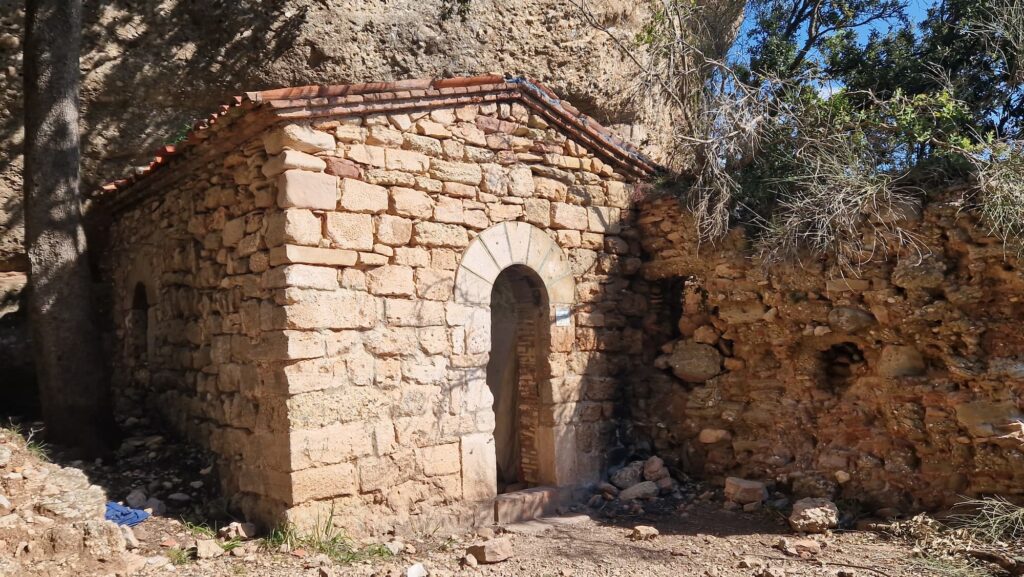
The hermitage of the Santíssima Trinitat occupied a privileged position within Montserrat and, as far as is known, was one of the largest and most comfortable in the entire hermitic complex. It was located in a relatively flat area, sheltered by the surroundings of Els Flautats and Sant Salvador — something quite unusual in such a rugged mountain.
Over time, it gained importance and eventually became one of the most valued and visited hermitages. Not only because of its location, but also due to its size and the higher level of comfort it offered compared to other, much more austere hermitages. In fact, it was also used at times by monks and other members of the monastery.
It was destroyed during the Napoleonic invasion and, although it was later rebuilt, hermitic life in this location eventually disappeared. Today, some remains are still visible, and walking through this area, it’s easy to understand why it was one of the most appreciated hermitages along this Montserrat hiking route.
Sant Dimes
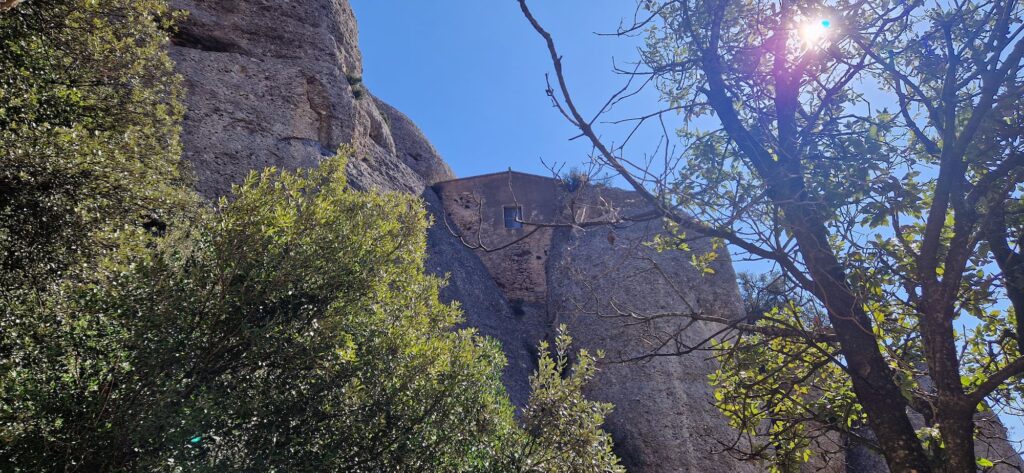
The hermitage of Sant Dimes is one of the most unique in Montserrat, both for its location and its history. It is situated very close to the monastery, in a striking rocky and elevated setting that was once linked to a small fortification. This is why, for a long time, it was also known as the “Hermitage of the Castle”.
Over time, that defensive structure disappeared and was replaced by the hermitage, dedicated to Sant Dimes, the Good Thief. Its position, perched on the rock with a very distinctive access, made it one of the most eye-catching and visited spots on the mountain. It also had an oratory that became very popular among pilgrims, giving this area a special role within the religious life of Montserrat.
The hermitage was destroyed during the Napoleonic invasion, like many others, later restored, and eventually fell again into a state of deterioration. Unlike other hermitages, Sant Dimes has remained visibly present to this day and continues to be one of the most characterful places along this Montserrat hiking route, both for its historical value and its spectacular setting. The only drawback is that it cannot be visited, as a gate blocks access, so it can only be admired from the path.
Linking routes?
This full hermitage circuit is one of the 15 routes in the guide — mapped, timed and graded.
Santa Creu
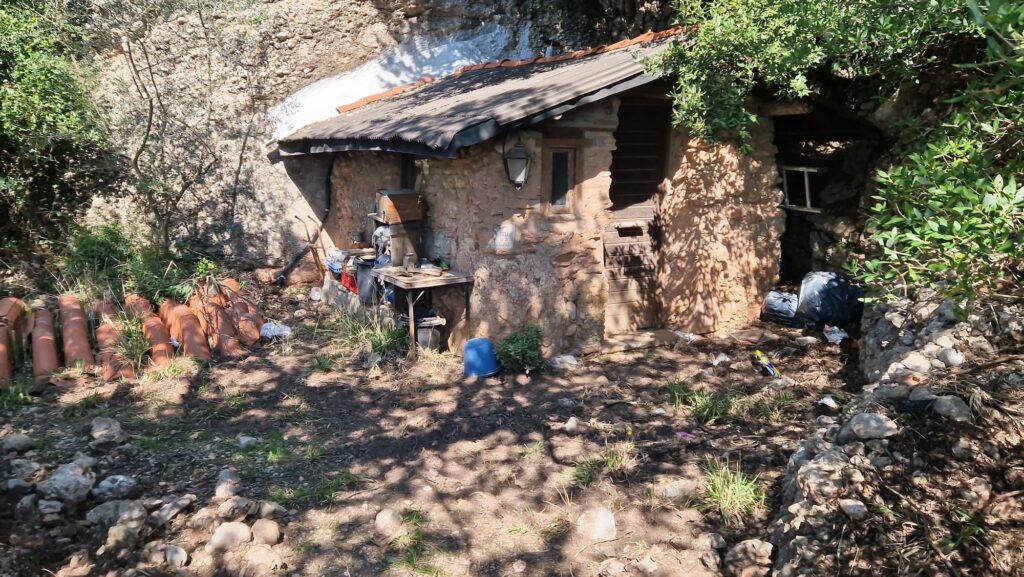
The hermitage of Santa Creu, also known at times as Santa Helena, was located in a very accessible area of Montserrat, right along the Escala Dreta path. For this reason, it became one of the most visited hermitages by pilgrims, as it was among the first they encountered when ascending from the monastery.
Its location, beneath an overhanging rock, provided partial protection and gave it a very distinctive character. It also had several cisterns — something quite unusual — which reflects the importance and frequent use of this place.
Over time, small oratories were added, changing their dedication, which reflects the evolution of this space within the religious life of the mountain. It was destroyed in the early 19th century, later rebuilt, and eventually abandoned, leading to its gradual deterioration.
Today, the site has been partially restored and is still occasionally used as a place for retreat along this Montserrat hiking route.
Sant Benet
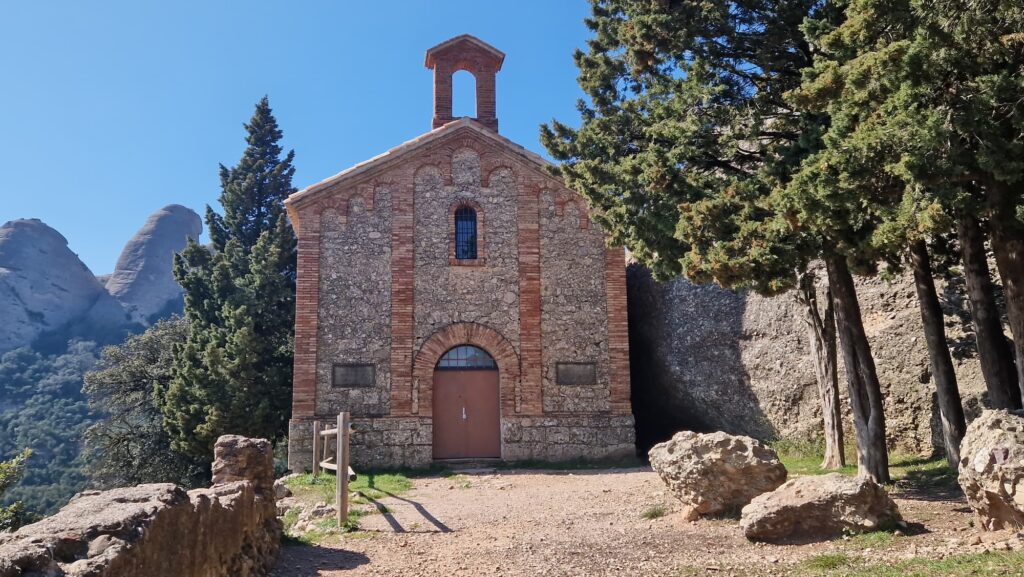
The hermitage of Sant Benet was located in an area relatively close to the monastery, connected by ancient paths that linked several hermitages across the massif. In fact, it was part of a very specific route alongside other hermitages, associated with a religious itinerary within Montserrat.
Because of its location, it became one of the most accessible and frequently used hermitages, even serving as a resting place for monks. Unlike other more isolated spots, the surroundings here were more welcoming, with gardened areas and spaces prepared for longer stays, making it one of the most habitable hermitages in Montserrat.
It was destroyed during the Napoleonic wars and later rebuilt, although hermitic life disappeared soon after. The current structure does not correspond to the original hermitage, and the site has had different uses over time, now functioning as a mountain refuge.
Within this Montserrat hiking route, Sant Benet is a good example of how some hermitages evolved over time, shifting from isolated places of retreat to more accessible and transformed spaces.
Santa Anna
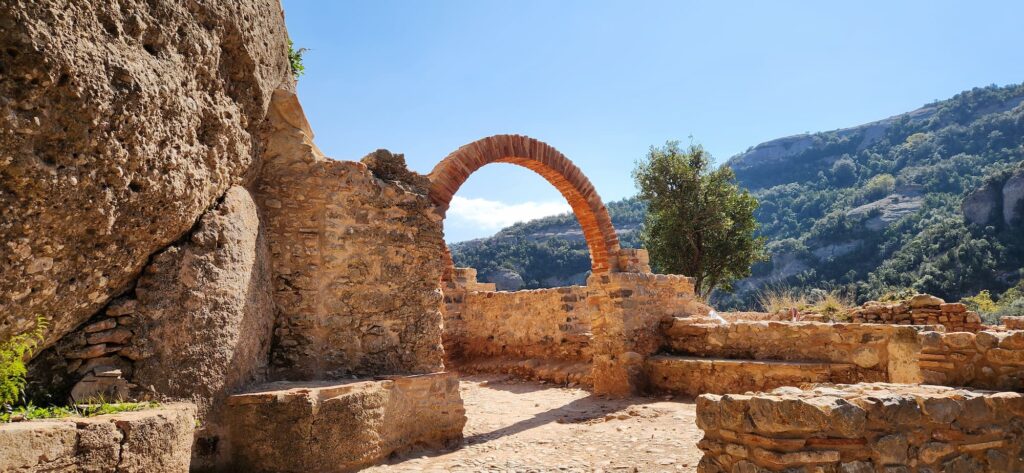
The hermitage of Santa Anna held a very special position within the group of hermitages in Montserrat. It was located close to the monastery and in a fairly central point relative to the others, which led it to be considered for a long time the main reference of the entire hermitage network.
In fact, rather than being an isolated hermitage, Santa Anna functioned as the “parish” of the rest. Hermits would gather here on specific days to confess, attend mass, and maintain their connection with the authority of the monastery. For this reason, its church was larger than most others and designed to host these gatherings.
It was built in the late 15th century and played a key role in the hermitic life of Montserrat. Over time, it was destroyed, and today only remains are left. Even so, it continues to be one of the most important points along this Montserrat hiking route, not only for its location but for what it represents within the spiritual organization of the mountain.
Despite being in ruins, the site is currently undergoing restoration, which further highlights its historical significance within any Montserrat hike focused on the hermitages.
As you continue along this first section of the massif on this Montserrat hike, the landscape changes completely. You move to a different side of the mountain and begin descending towards the monastery. From here, the route becomes more accessible and connects with a much more frequented area, typical of many Montserrat hiking trails.
At this point, the Montserrat hiking route leads towards the chapel of Sant Miquel. It’s important to clarify that, although it is often included among the hermitages of Montserrat, it is not actually a hermitage but a chapel. In fact, constructions like this already existed in the mountain long before the monastery was established and were part of the earliest religious spaces linked to Montserrat.
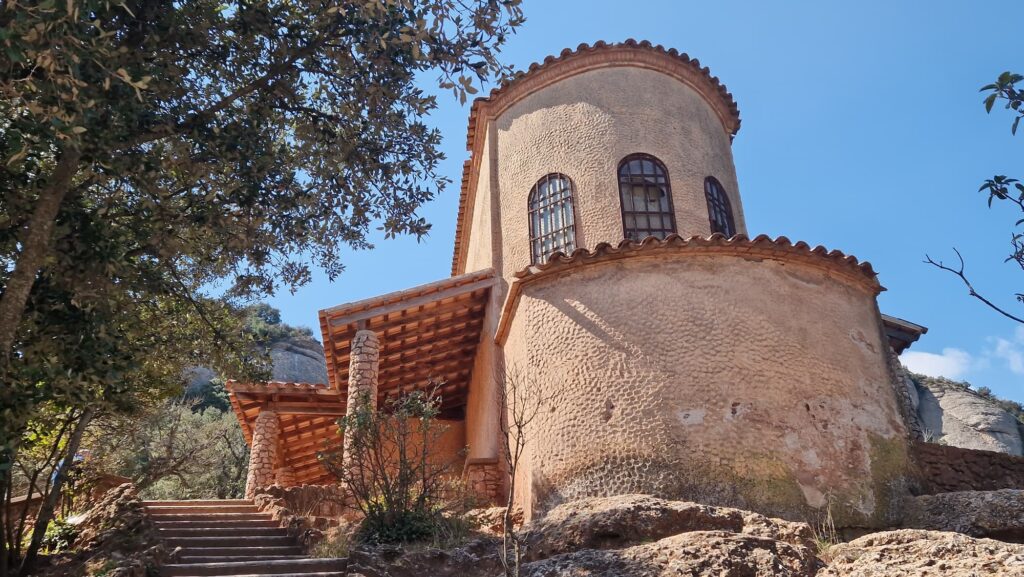
The chapel of Sant Miquel, together with others such as Sant Iscle, is one of the clearest examples of these early buildings. Its location, more accessible and closer to the monastery, contrasts with many hermitages, which are far more isolated and hidden across the massif—something that defines the experience of hiking in Montserrat.
From here, the Montserrat hike continues towards the Sant Joan funicular area, one of the most well-known and visited parts of the mountain. From this point on, you re-enter the more rugged and characteristic terrain that defines the best Montserrat hiking routes, heading towards the next stop: the hermitage of Sant Jaume.
One of the most spectacular spots along this Montserrat hike, both for its location and for the dramatic landscape that surrounds it.
Sant Jaume
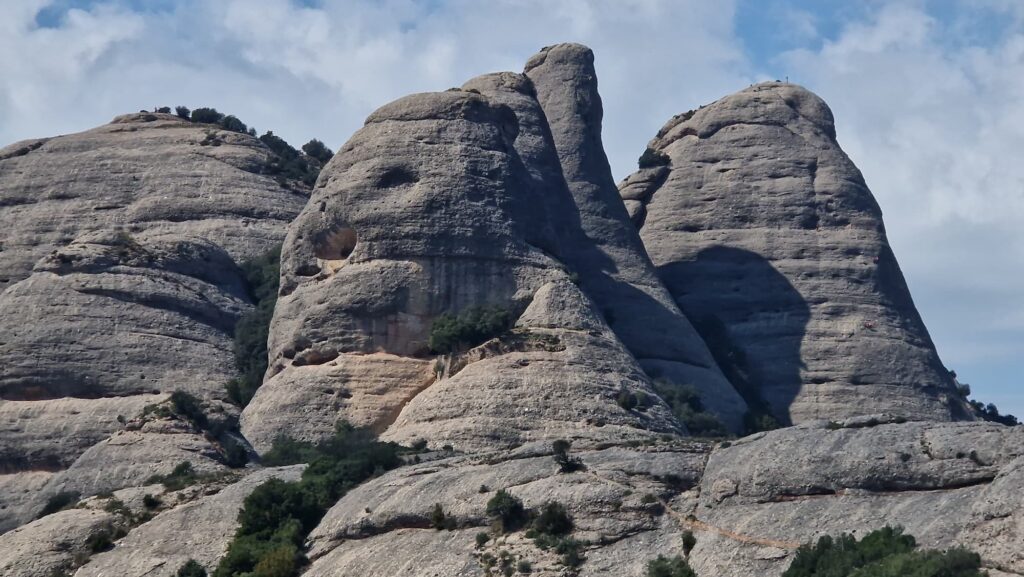
The hermitage of Sant Jaume is one of the most spectacular spots on any Montserrat hike, located halfway up the Gorra Marinera in a position that quite literally feels suspended from the rock. Thanks to its location, it was visible from the monastery and offered a privileged viewpoint over much of the massif—one of the highlights of this Montserrat hiking route.
This is a very exposed location with difficult access, and even in its time it was not easy to reach. For those hiking in Montserrat today, it still conveys that same sense of isolation and verticality. The hermitage was built by taking advantage of a natural rock shelter, as many others were along this Montserrat hiking trail, adapting the mountain itself into a place of refuge.
From here, during this Montserrat hike, you can see a large part of the hermitage network across the mountain. According to historical accounts, it was even possible to hear the chants and sounds coming from the monastery, adding to the unique atmosphere of this Montserrat hiking experience.
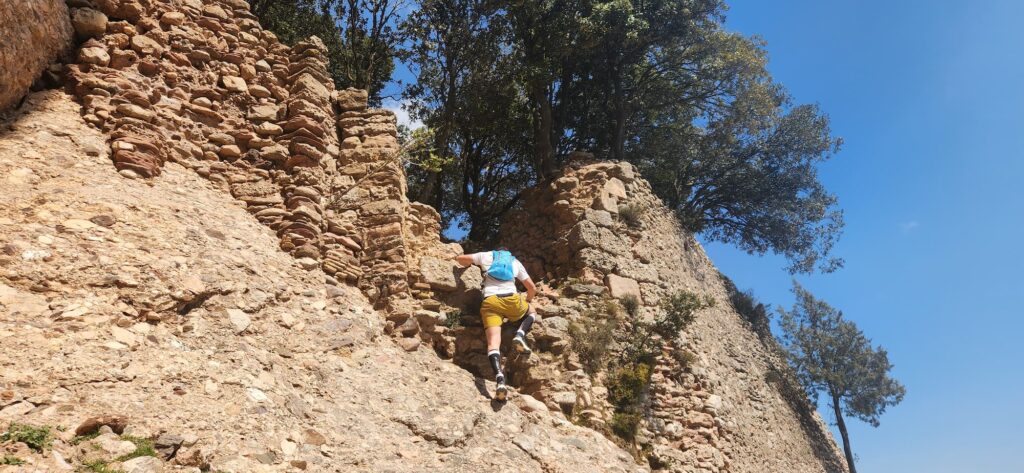
It was destroyed in 1812 and today only a few remains are left, but the location is still one of the most impressive highlights of any Montserrat hike and one of the most striking points along this Montserrat hiking route.
Santa Caterina
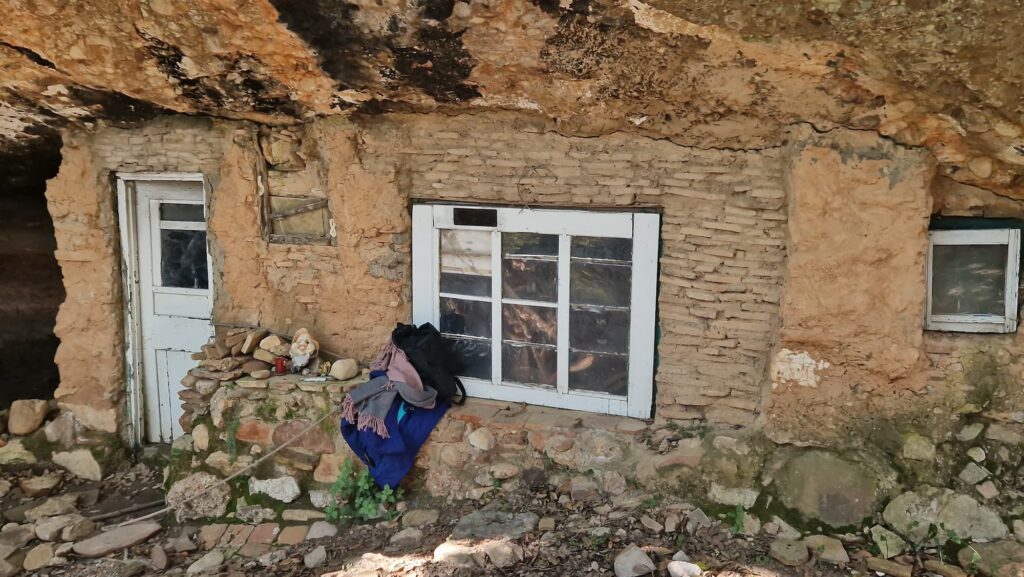
The hermitage of Santa Caterina was located in one of the most isolated and quiet areas of Montserrat, set at the bottom of a small hollow protected by the surrounding rock. Unlike other more exposed hermitages, the environment here is much more sheltered, away from passing hikers and with a strong sense of isolation, something that stands out when hiking in Montserrat.
This place was known as one of the quietest spots on the mountain, and it was traditionally associated with a large presence of birds, attracted by the water from the nearby Santa Caterina stream. This combination of water, vegetation, and natural protection made it an ideal setting for hermitic life along this Montserrat hiking route.
The hermitage had water cisterns and was located close to other areas linked to ancient settlements. It was destroyed in 1812, like all the others. Today, a small refuge stands in its place.
Within this Montserrat hike, Santa Caterina stands out precisely for this reason: not so much for its views, but for the deep sense of calm and isolation that defines this part of the Montserrat hiking experience.
Sant Joan
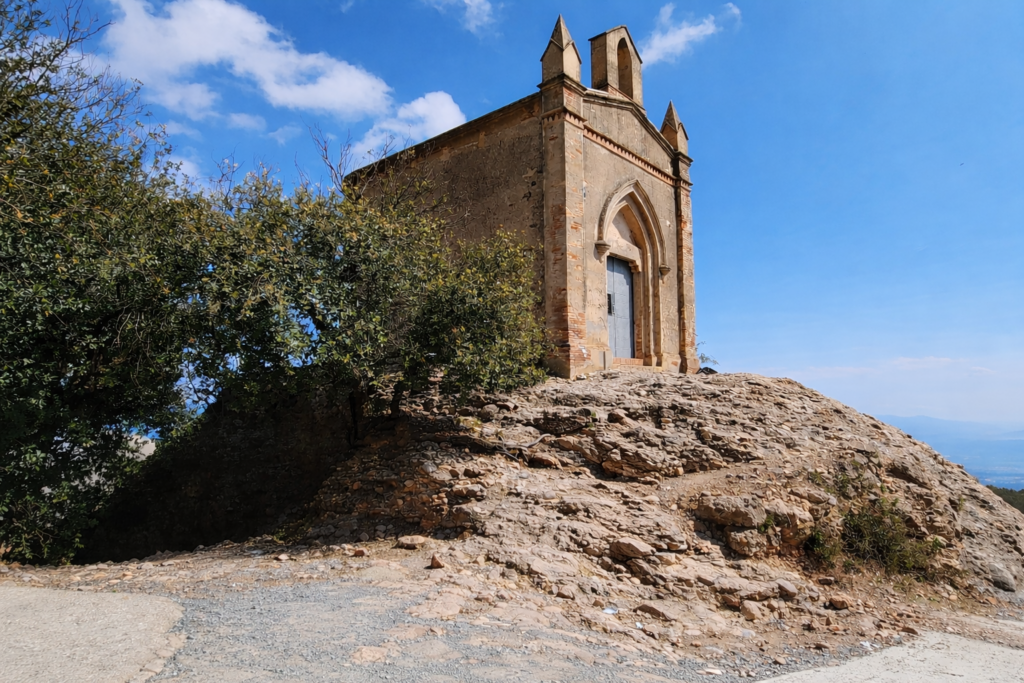
The hermitage of Sant Joan is one of the most well-known spots on any Montserrat hike, located in a privileged setting very close to Sant Onofre. It was built by taking advantage of a large natural rock shelter, which gave it more space and comfort than many other hermitages, along with wide open views over much of the mountain—one of the highlights of this Montserrat hiking route.
For a long time, it was a highly valued place, both for its orientation and its livability. Some abbots chose to retreat here at different moments, and even King Philip II visited this hermitage during one of his trips to Montserrat. It was also connected to important historical paths across the mountain, including those leading towards the Sant Jeroni area, a key point when hiking in Montserrat.
The two hermitages, Sant Joan and Sant Onofre, were located very close to each other. However, over time, direct communication between them was avoided to preserve the isolation of the hermits—one of the defining aspects of the Montserrat hiking experience. The hermitage was destroyed in 1812 and was later abandoned.
Sant Onofre
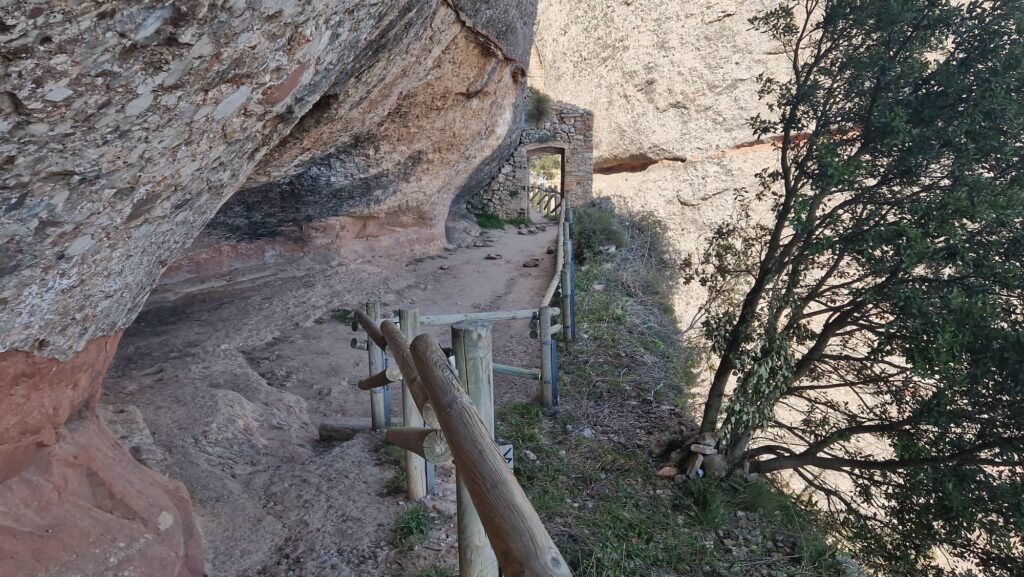
The hermitage of Sant Onofre is one of the most impressive highlights of any Montserrat hike, mainly due to its dramatic location, literally carved into the rock and suspended above the void. It was built by taking advantage of natural cavities, creating a space fully integrated into the mountain, with an access that, even in its time, was both striking and intimidating—something that still defines this Montserrat hiking experience.
To reach it, you had to climb a staircase carved directly into the rock and cross a small exposed section, reinforcing the sense of isolation that hermits were seeking. This access, now partially restored, still conveys that feeling of an inaccessible and remote place, which is one of the defining aspects of hiking in Montserrat.
The hermitage had several rooms and water cisterns, and for a period it was connected to the nearby hermitage of Sant Joan. However, this connection was later removed to preserve the solitude between both spaces, something very characteristic of the hermitages found along this Montserrat hiking route.
It was destroyed in the 19th century and remained hidden for many years, until parts of its access were recently recovered. Within this Montserrat hike, Sant Onofre stands out as one of the most spectacular points, both for its surroundings and for the sense of exposure and verticality that defines this section of the Montserrat hiking trail. A truly unique place.
Santa Magdalena
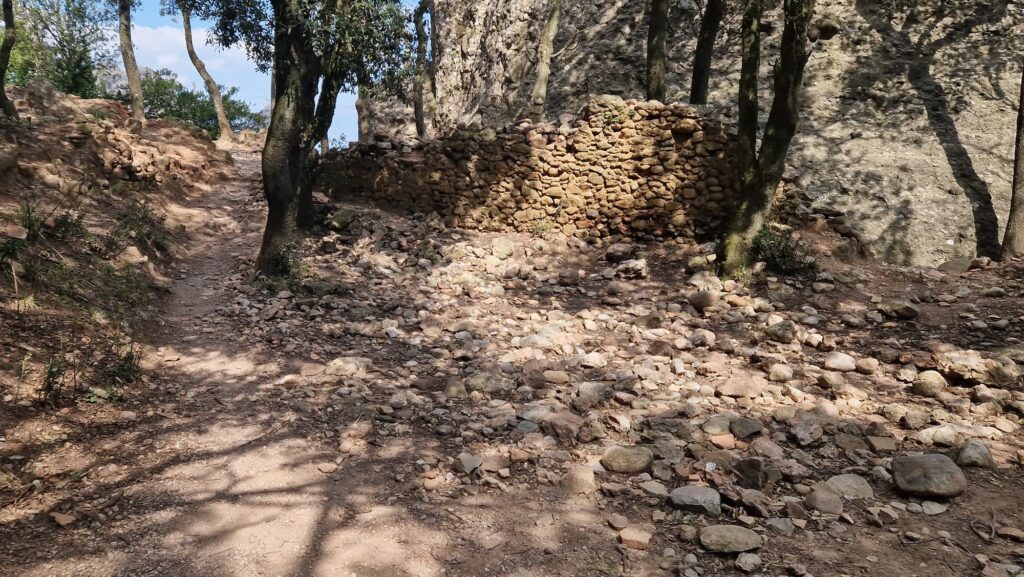
The hermitage of Santa Magdalena was located in a high and very exposed area of Montserrat, with direct views over the mountain massif. Its access was not easy, as it required climbing sections with steps carved into the rock, giving a clear idea of the type of terrain you encounter on this Montserrat hike.
Due to its location, it was a place heavily exposed to the wind, which reinforces the strong sense of isolation that characterizes many of the hermitages across the massif. Even so, it was an important point along the route between Sant Jeroni and other nearby hermitages, and it is likely that different structures existed in this area over time—something that adds depth to the experience of hiking in Montserrat.
It was destroyed in 1812 and today only a few remains are left, although you can still identify elements of the original access and the surrounding area where it once stood. It is also a perfect point to reach the nearby and iconic Miranda de Santa Magdalena, one of the best viewpoints along this Montserrat hiking route.
Within this Montserrat hike, Santa Magdalena stands out for its location and its views, making it one of those places where you truly understand the harshness of hermitic life in the mountain and the raw beauty of the Montserrat hiking experience.
At this point of the Montserrat hike, you could head back and reconnect with Coll de Santa Magdalena to join the Camí Nou de Sant Jeroni. However, in our case, we take a different path, deviating towards a spot located between the well-known Gorra Frígia and Magdalena Superior—one of those hidden corners you often discover when hiking in Montserrat.
Here you’ll find the so-called hermitage of Sant Martí, which in reality is not part of the historical group of hermitages of Montserrat, nor of its hermitic life. Rather than a true hermitage, it is a rock shelter that was adapted and built to serve as a refuge along this Montserrat hiking route.
Even so, the place is well worth a visit. It’s located in a particularly beautiful and charming corner of the mountain, offering a different perspective of the landscape that enriches the overall Montserrat hiking experience. That said, it’s important to clarify: Sant Martí should not be considered a hermitage within the historical route of the Montserrat hermits.
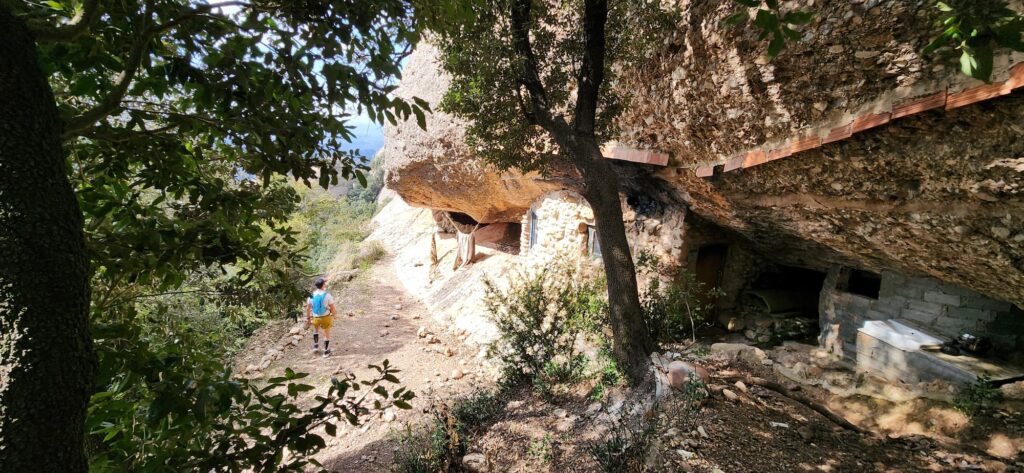
This point has difficult access and a challenging return, so if you decide to visit it during your Montserrat hike, make sure to take these added difficulties into account.
Tips Before Doing This Montserrat Hike
The 13 hermitages route is a long and demanding Montserrat hike, so it’s important to take several factors into account before starting.
The first thing to consider is the starting point. Although you can begin from Santa Cecília, starting from the monastery significantly reduces the difficulty and makes this Montserrat hiking route more manageable if you’re not looking for such a tough day.
There are no water sources along the route, except near the Sant Joan funicular area, so it’s essential to carry enough water from the beginning of your Montserrat hike.
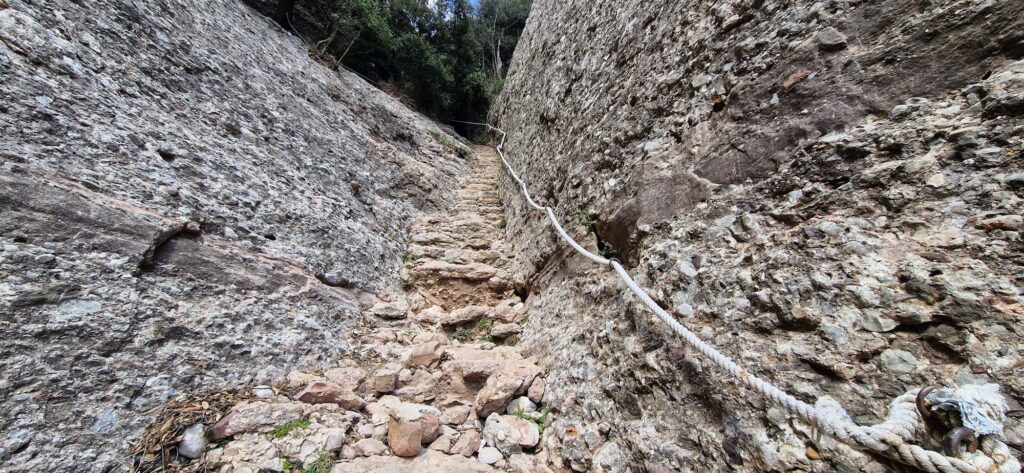
There are exposed sections and areas where the path is not clearly marked. It’s important not to take unnecessary risks and not to continue if you’re unsure about the route or lack sufficient mountain experience something to keep in mind when hiking in Montserrat.
Using GPS is almost essential. Having the track loaded on your phone and your battery fully charged can make a big difference, especially in the more confusing sections of this Montserrat hiking route.
Finally, it’s highly recommended to start early. This is a Montserrat hike that will take up most of your day, so you should plan according to the available daylight hours to avoid problems towards the end of the route.
Is the 13 Hermitages Montserrat Hike Difficult?
The 13 hermitages route is a demanding Montserrat hike when done in full. It’s not a route designed for casual tourists, as it combines long sections, elevation gain, and some exposed passages.
However, it can be easily adapted by shortening the route or starting from the monastery, which significantly reduces the difficulty of this Montserrat hiking route.
In any case, it is better suited for people with some mountain experience or a good level of fitness, especially when hiking in Montserrat.
How to Get to Montserrat for This Hike?
Montserrat is located about 1 hour from Barcelona, and getting there is relatively easy. However, choosing the right option can make a big difference—especially if you’re planning to do a long and demanding hike like the 13 hermitages route.
Here are the main ways to get to Montserrat:
Train + Rack Railway (Best overall option)
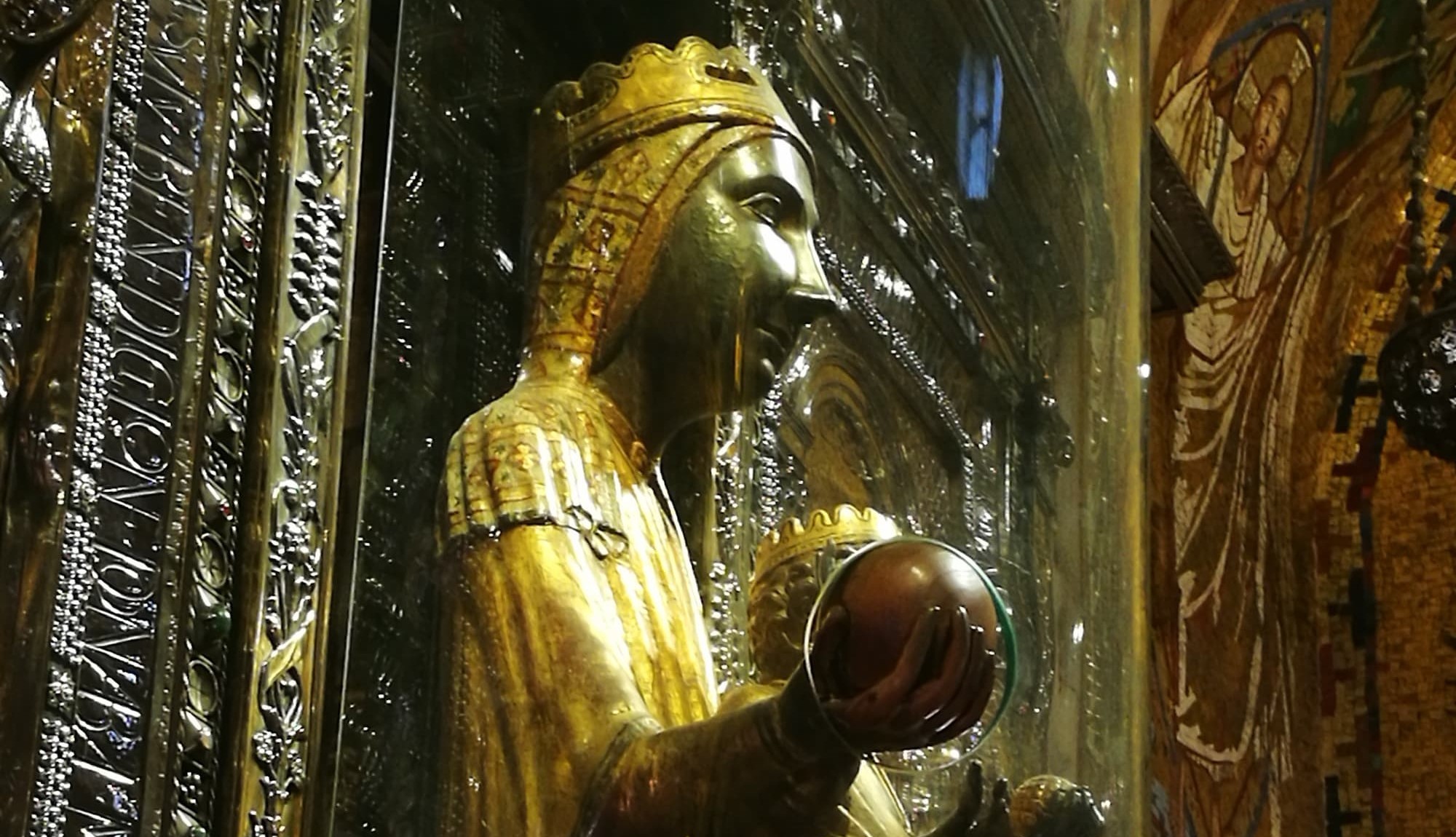
This is the most practical and balanced option for most travelers.
You take the FGC train from Plaça d’Espanya in Barcelona and get off at Monistrol de Montserrat. From there, the rack railway takes you directly up to the monastery.
- Total time: around 1h 30min
- Easy and well-organized
- No steep exposure like the cable car
- Ideal if you want a smooth and predictable start
If you’re planning to start the hike from the monastery, this is one of the best ways to get there.
Train + Cable Car (Most scenic option)
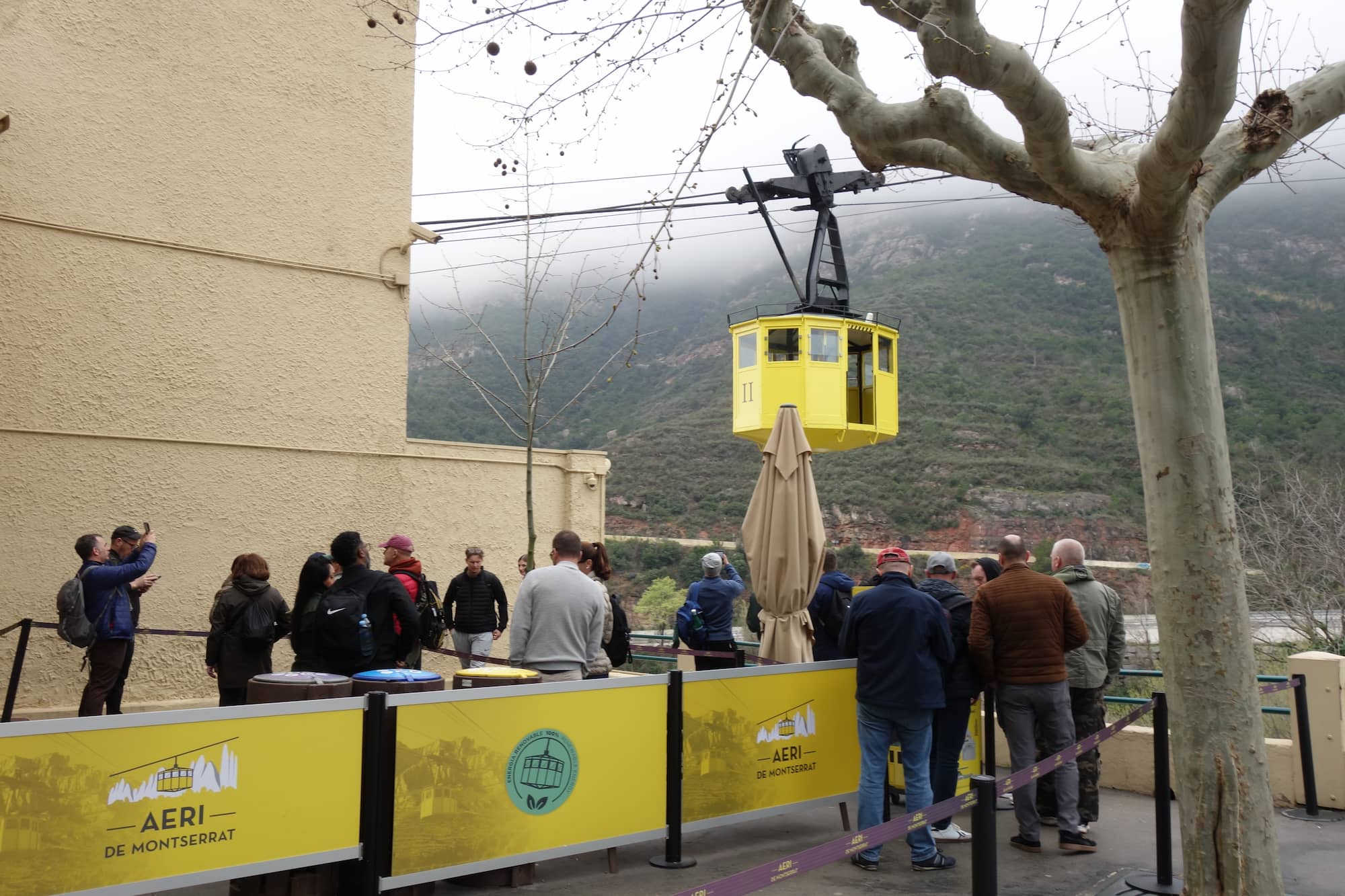
This is the most spectacular way to reach Montserrat.
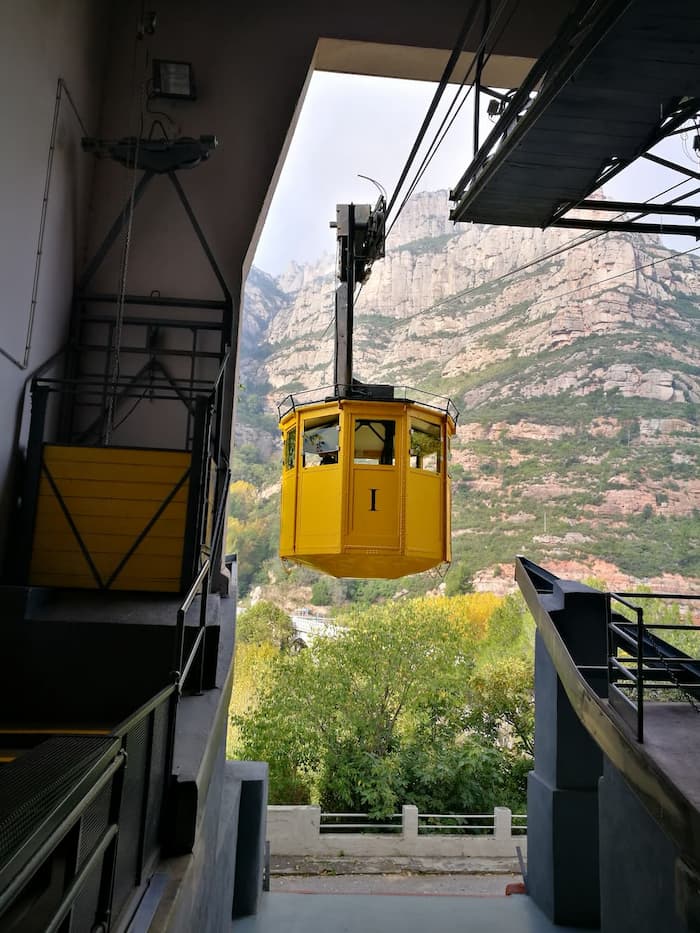
You take the same train from Barcelona but get off at Aeri de Montserrat, where the cable car takes you straight up the mountain in just a few minutes.
Total time: around 1h 15min
Very scenic and unique experience
Short but intense ride
Not ideal if you’re afraid of heights
If you want something memorable and visual, this is the option.
By Car (Best for flexibility)
Driving is a good option if you want full control over your schedule.
You can park:
- Near the monastery (limited spots)
- In Monistrol and continue by rack railway
- At Aeri de Montserrat and continue by cable car.
If you’re not sure which option to choose, you can check this comparison to find the best one for your visit.
Guided Tours from Barcelona (Most convenient option)
If you prefer not to deal with logistics, connections, or planning, a guided tour is the easiest solution.
Most tours include:
- Transport from Barcelona
- Access to the monastery
- Optional free time for hiking
This is a good option if you’re short on time or want everything organized in advance.
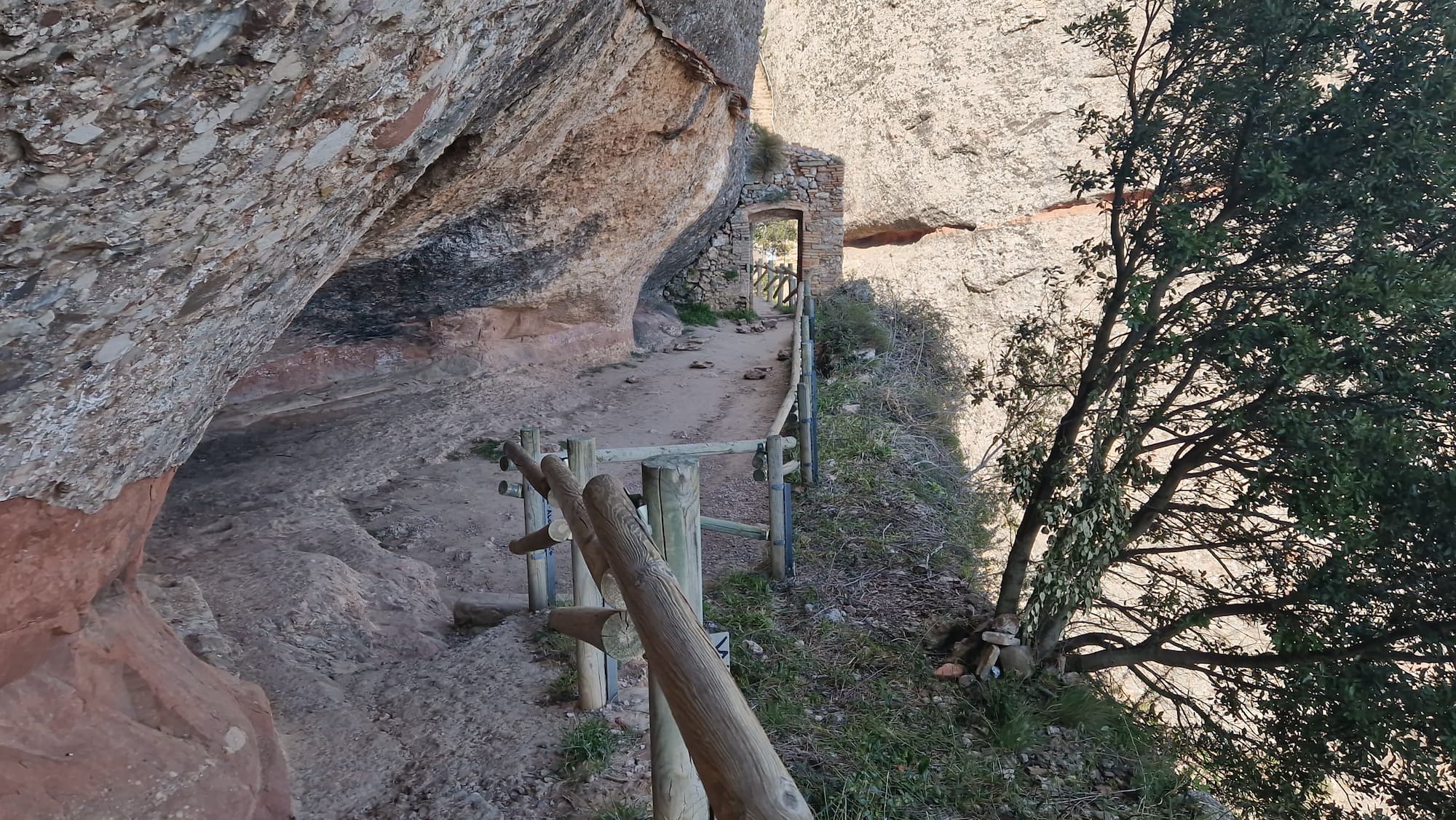
Final Tips Before You Go
- Start early — this is a long route
- Bring enough water (there are no reliable sources on the trail)
- Wear proper hiking shoes
- Check the Montserrat weather before going
- Download the route offline (signal can be weak in some areas)
If you want to follow the exact route, you can download it here.
Is It Worth It?
The 13 hermitages route is one of the most complete and authentic ways to explore Montserrat.
It’s not the easiest hike, but if you’re prepared, it offers a unique combination of history, solitude, and incredible views that most visitors never get to experience.
If you’re looking for something beyond the typical tourist visit, this hike is absolutely worth it. Enjoy it.
Final recommendation
If you’d prefer a guided experience, check out our selection of the best Montserrat tours from Barcelona.
Continue exploring Montserrat

If this guide helped you plan your visit, then it has done its job.
Sergio López Prieto · Local Montserrat Expert
Some links may be affiliate links, at no extra cost to you.