Montserrat Monastery is the spiritual heart of Montserrat and one of the most important religious sites in Catalonia. Set high in the mountain above the Llobregat valley, it combines a Benedictine abbey, a Marian sanctuary, the Basilica of Montserrat, the Black Madonna, monastic buildings, courtyards, viewpoints and visitor services.
For many travellers, Montserrat Monastery is the main reason to visit the mountain. For others, it is the starting point before exploring the funiculars, viewpoints or hiking trails. In both cases, understanding what the monastery is — and what it is not — will make your visit much better.
This guide focuses on the monastery itself: its history, the monks who live there, the main areas visitors can see, and how it fits into a day trip from Barcelona.
What is Montserrat Monastery?
Montserrat Monastery, officially linked to Santa Maria de Montserrat, is a Benedictine monastery and sanctuary located in the Montserrat mountain range, about one hour from Barcelona.
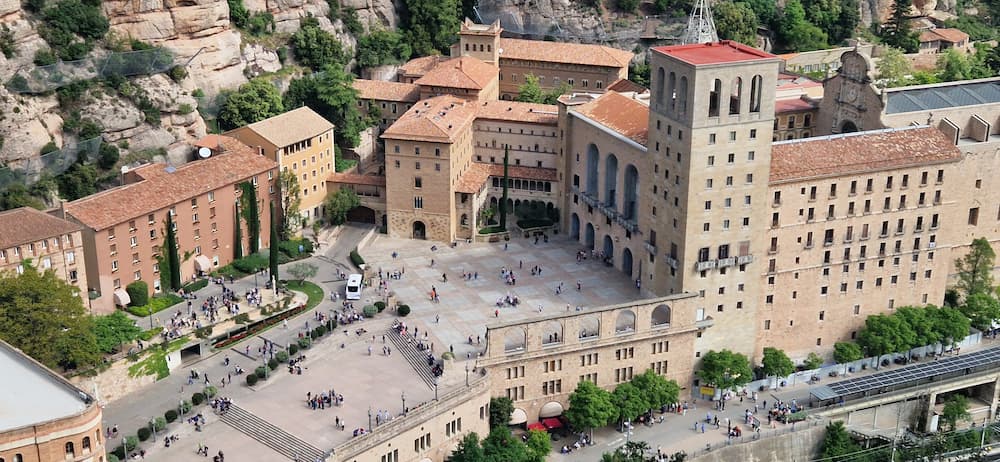
When visitors refer to the “Monastery of Montserrat,” they are usually referring to the entire religious complex surrounding the basilica. This includes the abbey, the sanctuary, the atrium, the high altar, the presbytery, the courtyards, the monastic buildings, the cambril, the museum area, and the open spaces surrounding the main square. To better understand it, think of Montserrat as a Benedictine monastery with the status of an abbey, which functions as a Marian shrine, and whose church holds the title of minor basilica.
This is important because the monastery is not just one isolated building. It works more like a small mountain sanctuary, with religious life, tourism, culture, transport stations, viewpoints and walking routes all concentrated in the same area.
The basilica and the Black Madonna are part of the experience, but they deserve their own detailed guides. This article keeps the focus on the monastery as a whole.
Why is Montserrat Monastery important?
Montserrat Monastery is important for three reasons: religion, history and Catalan identity.
Religiously, it is one of the most important Marian sanctuaries in Europe. The devotion to the Virgin of Montserrat, also known as La Moreneta or the Black Madonna, has attracted pilgrims for centuries.
Historically, the monastery has survived wars, destruction, abandonment, reconstruction and political tension. Its story reflects many of the major changes in Catalan and Spanish history.
Culturally, Montserrat has become one of the great symbols of Catalonia. It is not only a place of worship, but also a centre of music, learning, publishing, hospitality and cultural preservation.
That is why Montserrat is different from many other day trips from Barcelona. You are not just visiting a scenic mountain. You are visiting a place where landscape, religion, history and identity meet.
A brief history of Montserrat Monastery
Historical background A brief history of Montserrat Monastery Recommended reading
The spiritual history of Montserrat Monastery began before the monastery was officially founded. Tradition connects the mountain with the discovery of the image of the Virgin in the 9th century. Around that time, several small chapels existed on the mountain, including Santa Maria, Sant Iscle, Sant Pere and Sant Martí.
Only the chapel of Sant Iscle still survives today. It is located within the monastery area, although it is not one of the main places most first-time visitors notice.
The monastery itself was officially founded in 1025 by Abbot Oliba, one of the most important religious figures in medieval Catalonia. From that moment, Montserrat began to grow as a monastic and pilgrimage centre.
During the 12th and 13th centuries, a Romanesque church was built at Montserrat, and pilgrims increasingly came to venerate the image of the Mother of God. Over time, the fame of Montserrat spread beyond Catalonia.
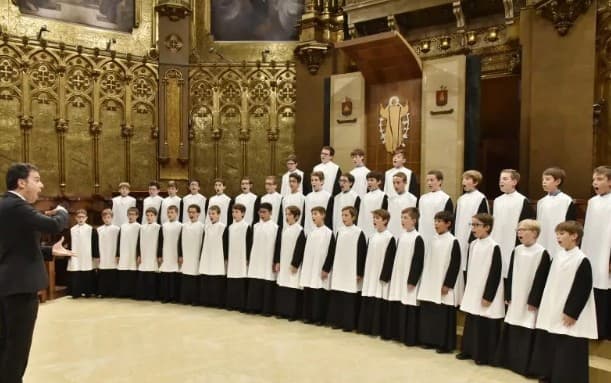
In 1223, there is already evidence of a boys’ choir at Montserrat, making the Escolania de Montserrat one of the oldest musical institutions in Europe. In 1409, Montserrat became an independent abbey. In 1490, the monastery installed its own printing press, strengthening its cultural role.
Montserrat’s influence also reached the Americas. In 1493, the hermit Bernat Boïl travelled with Christopher Columbus, and the name Montserrat was later given to one of the islands in the Caribbean. This helped spread devotion to the Virgin of Montserrat beyond Europe.
The 19th century was one of the most difficult periods in the monastery’s history. In 1811 and 1812, Napoleon’s army destroyed much of Montserrat. Later, in 1835, the confiscation laws caused the monastery to lose its properties, and almost all the monks left.
The monks returned in 1844, and a long process of reconstruction began. In the second half of the 19th century, Montserrat gradually recovered its religious, cultural and symbolic importance.
The 20th century brought more difficult moments. During the Spanish Civil War, the monks had to leave the monastery, and several members of the community were killed. However, the monastery itself was saved from destruction and looting.
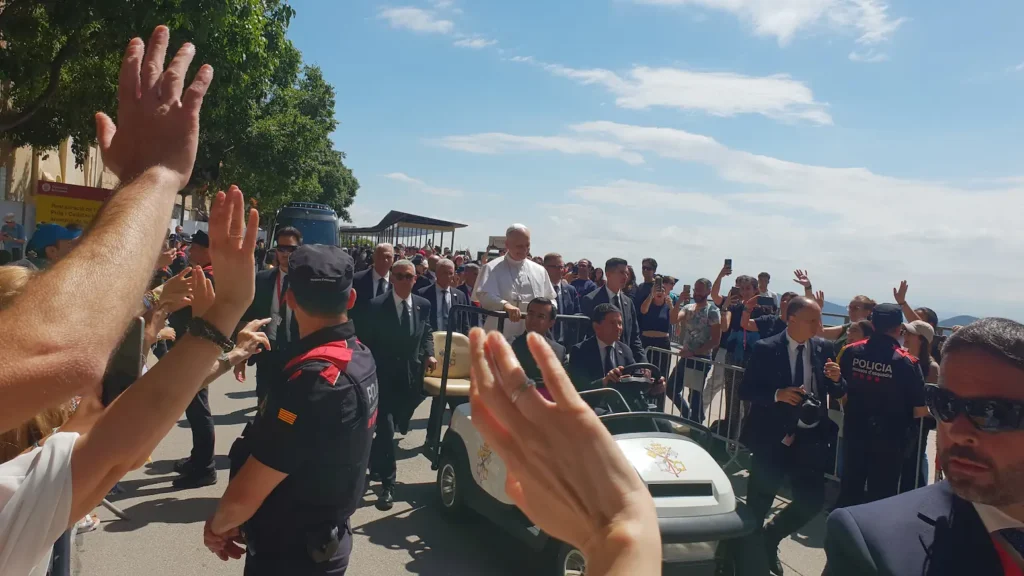
After the war, Montserrat continued to rebuild and expand. In 1947, the Enthronement of the Virgin became an important religious and civic event in Catalonia. In 1982, Pope John Paul II visited Montserrat. In recent decades, the basilica, museum and visitor areas have been restored and improved to welcome the large number of pilgrims and travellers who arrive every year.
The monks of Montserrat
Montserrat is not only a tourist attraction. It is still an active Benedictine monastery.
The monks follow the Rule of Saint Benedict, a tradition based on prayer, work, community life and hospitality. Their daily life is centred on liturgical prayer, study, service and the care of the sanctuary.
The monastic community has changed over time, but the monastery remains a living religious house. Some monks are involved in the internal life of the abbey. Others work in areas such as theology, history, biblical studies, liturgy, music, teaching, research, publishing or the reception of pilgrims.
Some also collaborate with the Escolania de Montserrat, the famous boys’ choir. This includes musical training, liturgical work, composition, research and cultural projects connected with the choir.
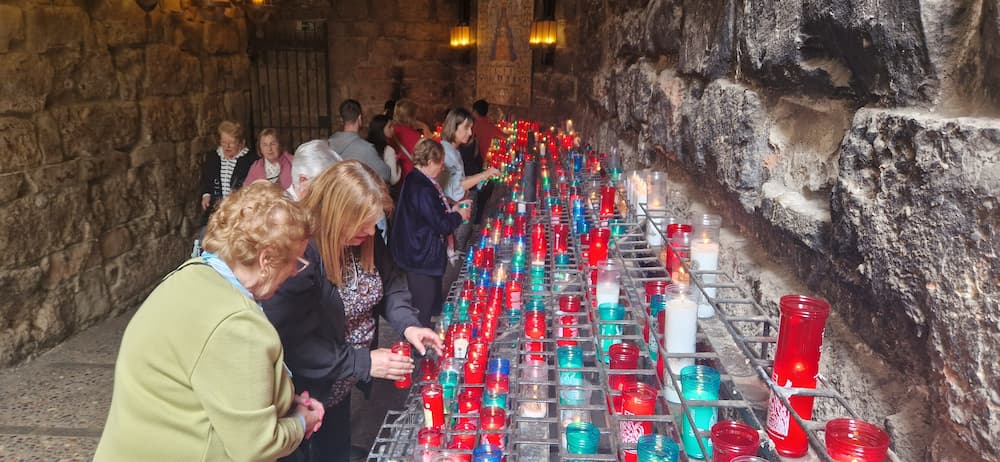
For visitors, this matters because Montserrat should not be treated only as a monument. It is a living monastery. The basilica, the sanctuary and the surrounding areas are used by pilgrims, worshippers, monks, school groups and tourists at the same time.
A respectful visit is part of the experience.
Can you visit the monks’ area?
No, the private monastic area is not generally open to the public.
The monks live in buildings connected with the monastery, close to the basilica area. Visitors can walk through the public parts of the sanctuary, enter the basilica, visit the museum, access viewpoints and use the visitor services, but the residential and internal areas of the monastery are private.
If you want to understand more about the daily life of the monks, the best option is to visit the audiovisual and cultural spaces of Montserrat, where part of the monastic life and history of the sanctuary is explained.
Can you contact the monks of Montserrat?
In specific cases, yes. The monks are separate from the commercial and tourism services of Montserrat.
Contact with the monastic community is usually related to religious matters, retreats, spiritual stays, prayer requests or religious group visits. General tourism questions, transport issues, tickets, restaurants, shops or guided tours should not be directed to the monks.
For normal travel planning, use the official visitor services or book through transport and tour providers. For religious or spiritual enquiries, use the official channels of the abbey.
What can visitors see at Montserrat Monastery?
The main square and monastery exterior
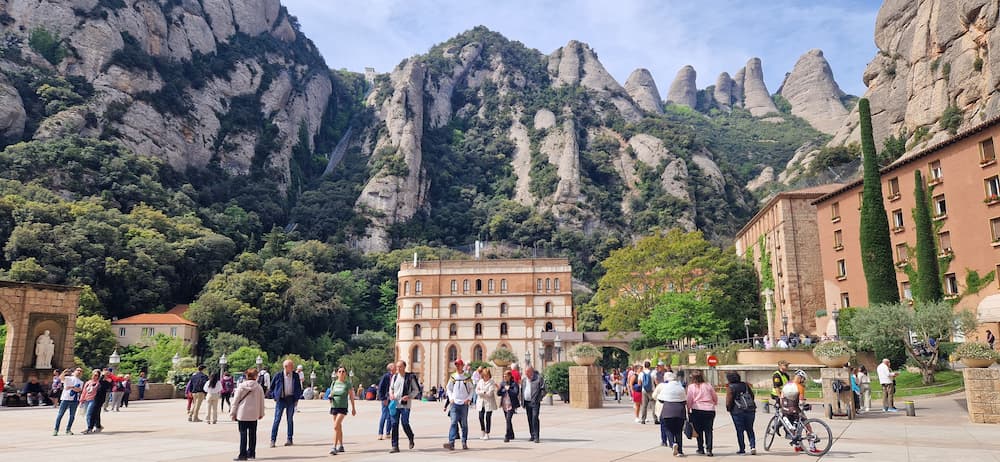
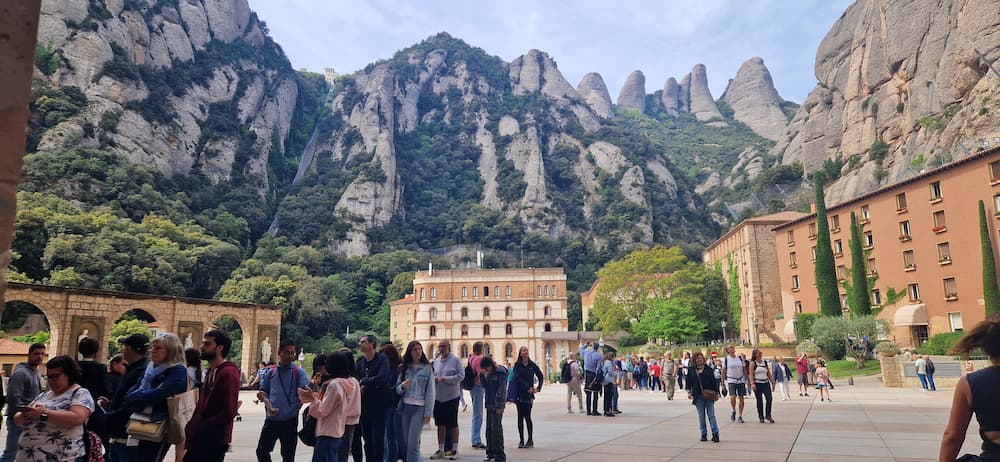
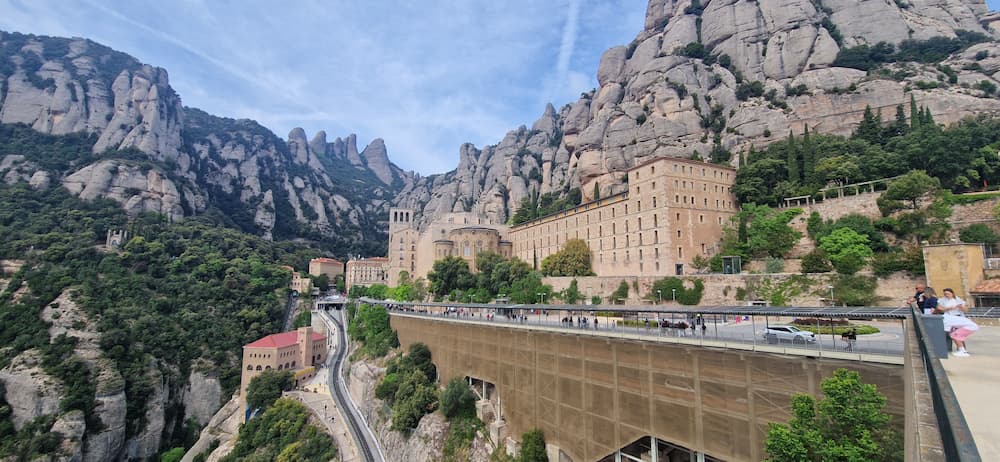
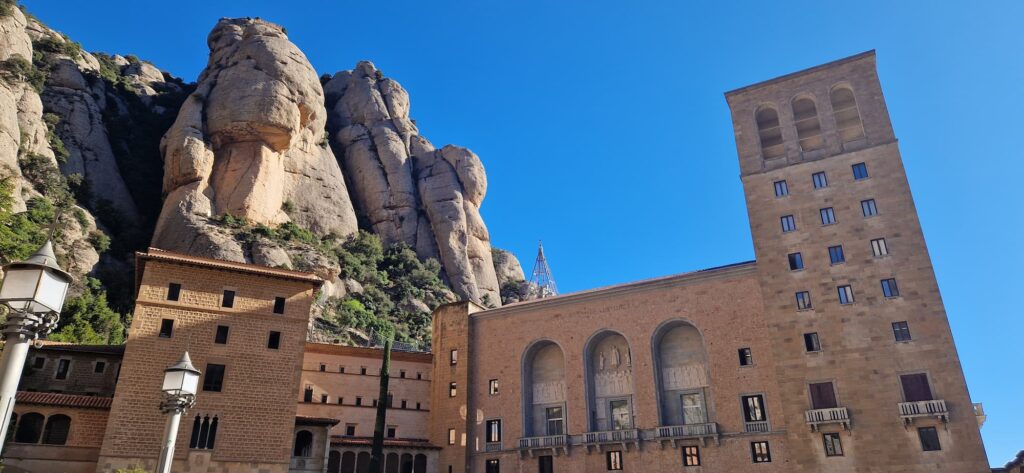
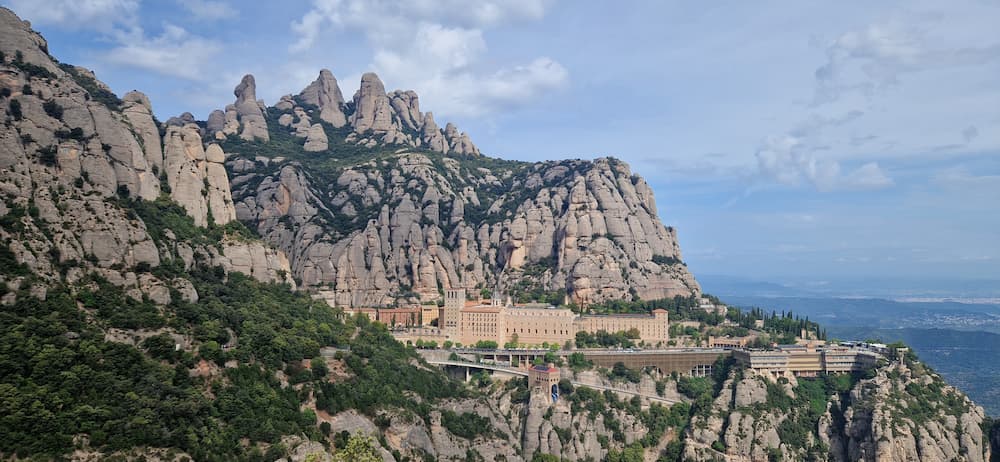
The main open area around the monastery is one of the best places to understand Montserrat visually. The buildings are set directly against the mountain, with the rock formations rising behind them and the valley opening below.
This combination of architecture and landscape is what makes Montserrat so powerful. The monastery is not impressive only because of its history. It is impressive because of where it stands.
Before entering the basilica, take a few minutes to look around the square, the façade, the mountain walls and the views behind you.
The basilica entrance and atrium
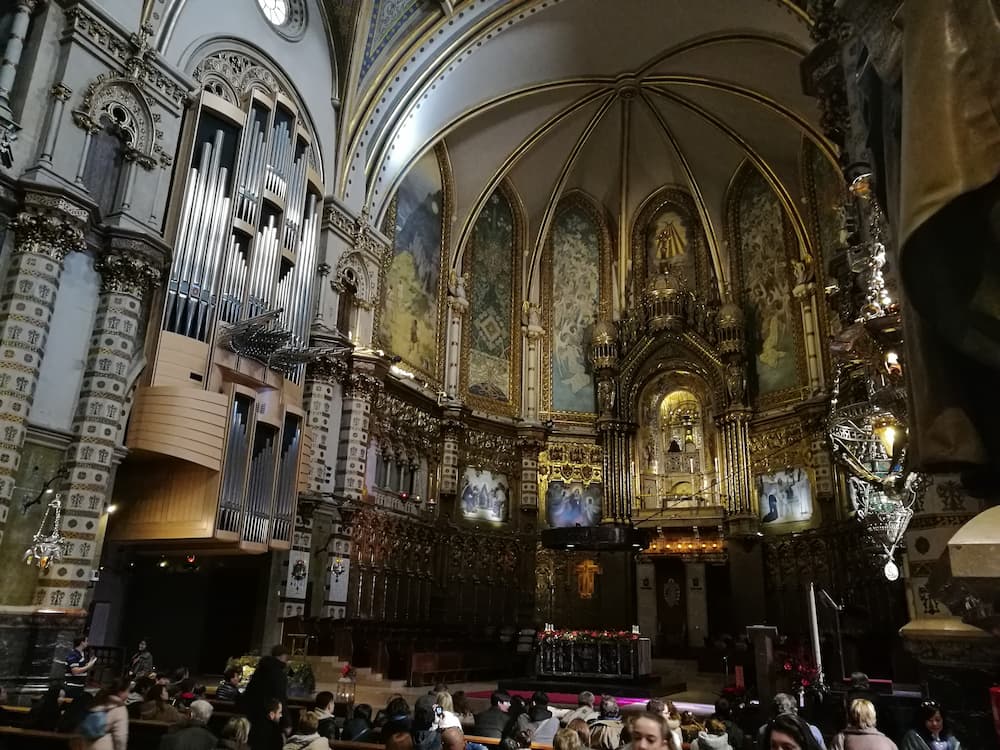
The basilica is the main religious space of the monastery complex. It is where visitors attend services, enter the church and access the route to the Black Madonna.
Because the basilica deserves its own guide, this article should not explain every detail of the interior. But for a first-time visitor, it is important to understand that the basilica is the central public religious space of Montserrat Monastery.
The Black Madonna
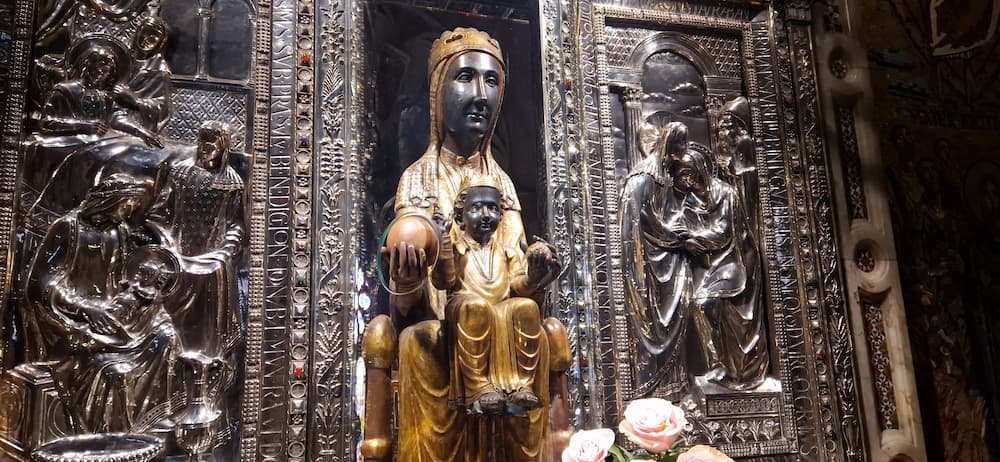
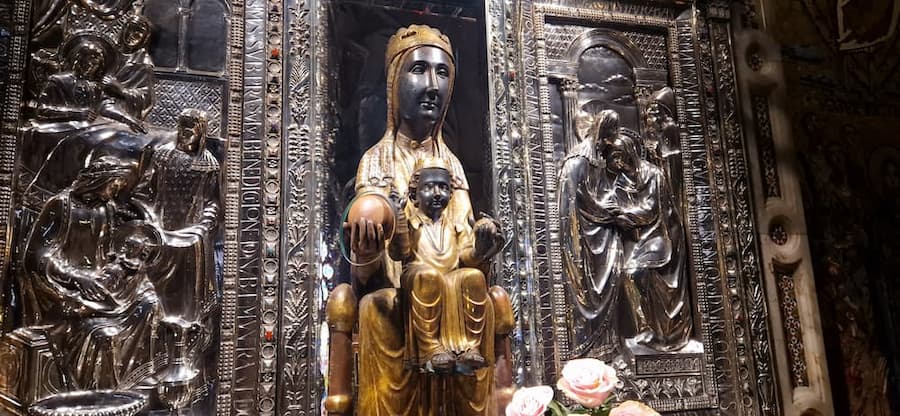
The Black Madonna, or La Moreneta, is the most important devotional image in Montserrat. The sanctuary developed around this devotion, and many pilgrims visit Montserrat specifically to see her.
For tourists, the Black Madonna is one of the most meaningful experiences in the monastery. However, it often requires planning because queues and reservation systems may affect the visit depending on the day and season.
The monastery courtyards and public areas
The public areas around the basilica help you understand the scale of the sanctuary. These spaces connect the basilica, the museum, visitor services, shops, restaurants and access points to other parts of Montserrat.
They are not just transit zones. They are part of the monastery experience, especially if you slow down and notice how the buildings, mountain and religious spaces are arranged together.
The views around the monastery
You do not need to hike to enjoy Montserrat’s scenery. From the open areas near the monastery, you already get excellent views of the mountain, the valley and the surrounding landscape.
This is one of the reasons Montserrat works so well as a day trip from Barcelona. Even visitors who do not take a funicular or follow a hiking trail can still experience the dramatic mountain setting.
The museum and cultural spaces
The Montserrat Museum and the cultural sites surrounding the monastery add extra value to your visit. They help you understand the artistic, historical, and spiritual significance of the place.
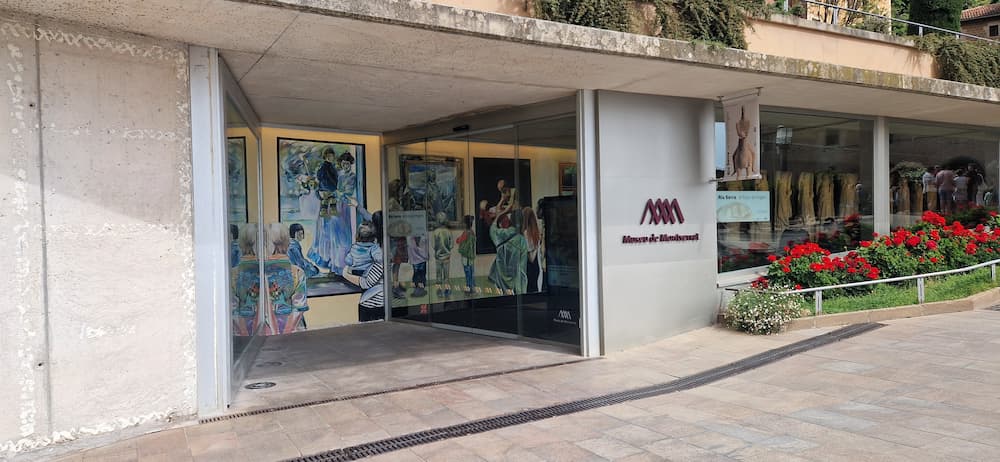
If you’re short on time, it’s best to start by visiting the monastery, the basilica, the Black Madonna, and the Holy Grotto, and to take in the views. If you have the whole day, the museum is highly recommended.
How much time do you need at Montserrat Monastery?
For the monastery area alone, allow at least 1.5 to 2 hours. That gives you time to walk through the main area, see the exterior, enter the basilica and enjoy the nearby views.
If you also want to visit the Black Madonna, listen to the Escolania, visit the museum, take a funicular or follow a short walking route, allow 3 to 5 hours. For a complete day trip from Barcelona, Montserrat can easily fill most of the day.
Best way to visit Montserrat Monastery from Barcelona
Most visitors reach Montserrat Monastery from Barcelona in one of this ways:
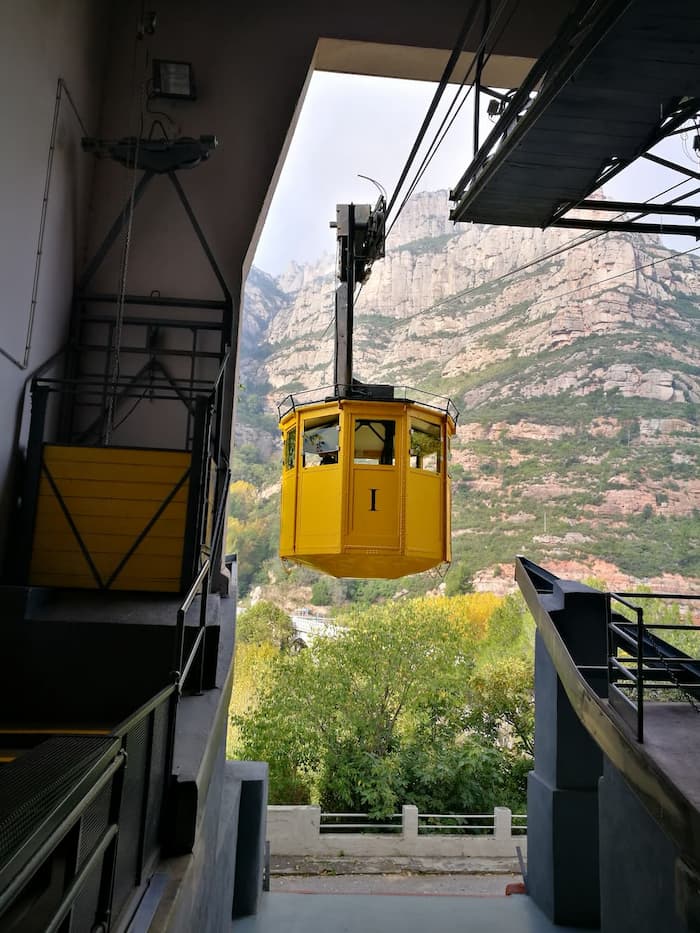
By train from Plaça Espanya, combined with either the rack railway or the cable car.
By car, which gives more flexibility but requires planning for parking and mountain road access.
By guided tour from Barcelona, which is usually the easiest option if you want transport, timing and explanations arranged for you.
For independent travellers, the train plus rack railway or cable car is the classic option. For visitors who want the simplest experience, a guided tour is often better.
This is especially true if your priority is the monastery itself, the basilica, the Black Madonna and the main views, rather than planning every transport detail yourself.
Recommended first-time itinerary
For a first visit, keep the order simple.
For a first visit to Montserrat, keep the route simple: monastery square, exterior views, Basilica, Black Madonna and the viewpoints near the monastery.
If you only have half a day, focus on the monastery, Basilica, Black Madonna and views. For a full-day visit, add the Museum, Santa Cova, Sant Joan funicular or one short mountain walk.
Start with the monastery square and exterior views. Then enter the basilica. If visiting the Black Madonna is important to you, plan that next. After that, spend time around the viewpoints near the monastery.
If you have more time, add the museum, the Santa Cova route, the Sant Joan funicular or a short walk.
For a half-day visit, focus on the monastery, basilica, Black Madonna and views.
For a full-day visit, combine the monastery with Santa Cova and one mountain experience.
Is Montserrat Monastery worth visiting?
Yes. Montserrat Monastery is worth visiting even if you are not religious.
The monastery gives meaning to the whole mountain. Without it, Montserrat would still be a spectacular natural site. With it, Montserrat becomes one of the most unique places in Catalonia: a mountain, a sanctuary, a monastery, a cultural symbol and a pilgrimage site all in one.
For most first-time visitors, the monastery should be the centre of the visit. Everything else — the funiculars, viewpoints, museum, Santa Cova and hiking trails — works best when you understand the monastery first.
Final recommendation
Montserrat Monastery is the best place to start your visit to Montserrat. It explains why this mountain became so important and why millions of people continue to come here every year.
Visit the monastery first. Take time to understand the setting, enter the basilica, respect the religious atmosphere and leave space for the views. After that, you can decide whether to continue with the Black Madonna, the museum, Santa Cova, Sant Joan or one of the hiking routes.
For the simplest visit from Barcelona, choose a guided tour. For more flexibility, use the train and combine it with the rack railway or cable car.
FAQ about Montserrat Monastery
Is Montserrat Monastery the same as Montserrat Basilica?
No. The basilica is the main church inside the monastery and sanctuary complex. The monastery is the broader Benedictine abbey and religious complex of Santa Maria de Montserrat.
Is Montserrat Monastery still active?
Yes. Montserrat is still an active Benedictine monastery. The monks live, pray and work there, although their private areas are not open to the public.
When was Montserrat Monastery founded?
Montserrat Monastery was founded in 1025 by Abbot Oliba.
Can tourists visit Montserrat Monastery?
Yes. Visitors can access the public areas of the monastery complex, including the basilica, courtyards, viewpoints, museum area and visitor services. Private monastic areas are not open to the public.
Can you contact the monks of Montserrat?
Yes, but only for appropriate religious or spiritual matters such as retreats, prayer requests or religious group visits. Tourism, ticketing and transport questions should go through visitor services or tour providers.
How long should I spend at Montserrat Monastery?
For the monastery area, allow 1.5 to 2 hours. For a fuller visit including the basilica, Black Madonna, views and another activity, allow 3 to 5 hours.
What is the best way to visit Montserrat Monastery from Barcelona?
The easiest independent option is the train from Barcelona with the rack railway or cable car. The easiest overall option is a guided tour from Barcelona, especially if you want transport and explanations included.
When the Pope Came to Montserrat
Continue exploring Montserrat

If this guide helped you plan your visit, then it has done its job.
Sergio López Prieto · Local Montserrat Expert
Some links may be affiliate links, at no extra cost to you.